That's today's sentence from "The Great Gatsby" (in the practically inexplicable Gatsby project).
I must say this sentence almost makes me angry, and I'm going to calm myself by diagramming it...
Another calming method I use when ingesting a Gatsby sentence is: Look for the light. Or: Look for the interplay of light and darkness. (I was just explaining that yesterday.)
In today's sentence, we've got "glistening" for the light (located in the hors d’œuvre), and "bewitched to a dark gold" for the darkness. It's interestingly mysterious that the darkness gets to be gold — a metal that normally is seen as glistening, especially when compared to hors d’œuvre, which... WTF?... are they greasy? Is there a spotlight aimed at them? It's also interesting that there's some bewitching going on, but that just seems to be a goofball way of referring to cooking, the cooking of turkeys and pastry pigs. Now, you know, about 9 days ago, I got all bent out of shape over F. Scott calling pork pig. But here it's quite possible that he's not talking about some cut of pork bewitched to a dark gold, but something pastry (with pork) molded into the shape of a pig.

So I'm not going to let that get my...

Are we through yet? Or is something in this insane undertaking requiring me to help you come to terms with the "salads of harlequin designs"? I found some crazy-ass salads Googling "harlequin salad." Like:

But we're looking for salads of harlequin designs, and I'm sorry, but there's just no design there. Mom and her ilk are simply using the word "harlequin" to mean multicolored. Harlequin design has got to refer to a much more distinctive diamond shape pattern typical of the Commedia dell'Arte character. Like this:

So I'm picturing some mound of edible material with criss-crossing strips of pimento. Ah! Here: "Fancy Salads of the Big Hotels." That book is from 1921, one year before the events in "The Great Gatsby" are supposed to take place. And here's Robert Salad:
Bewitching!
Read more ►
I must say this sentence almost makes me angry, and I'm going to calm myself by diagramming it...
hams | crowdedOkay. That's it! That's the action in this sentence. Hams crowded. Got that?
Another calming method I use when ingesting a Gatsby sentence is: Look for the light. Or: Look for the interplay of light and darkness. (I was just explaining that yesterday.)
In today's sentence, we've got "glistening" for the light (located in the hors d’œuvre), and "bewitched to a dark gold" for the darkness. It's interestingly mysterious that the darkness gets to be gold — a metal that normally is seen as glistening, especially when compared to hors d’œuvre, which... WTF?... are they greasy? Is there a spotlight aimed at them? It's also interesting that there's some bewitching going on, but that just seems to be a goofball way of referring to cooking, the cooking of turkeys and pastry pigs. Now, you know, about 9 days ago, I got all bent out of shape over F. Scott calling pork pig. But here it's quite possible that he's not talking about some cut of pork bewitched to a dark gold, but something pastry (with pork) molded into the shape of a pig.

So I'm not going to let that get my...

Are we through yet? Or is something in this insane undertaking requiring me to help you come to terms with the "salads of harlequin designs"? I found some crazy-ass salads Googling "harlequin salad." Like:
1 can of peasAnd here's a photograph of something called "Mom Dill's Harlequin Salad":
1 can of sliced beets, diced
1/2 cup Miracle Whip
1 chopped onion (optional)
Dice beets and onions and mix all together and refrigerate until cold. I usually quadruple the recipe because it goes fast.
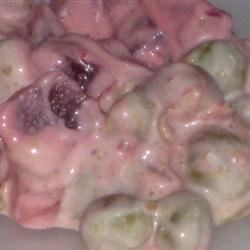
But we're looking for salads of harlequin designs, and I'm sorry, but there's just no design there. Mom and her ilk are simply using the word "harlequin" to mean multicolored. Harlequin design has got to refer to a much more distinctive diamond shape pattern typical of the Commedia dell'Arte character. Like this:

So I'm picturing some mound of edible material with criss-crossing strips of pimento. Ah! Here: "Fancy Salads of the Big Hotels." That book is from 1921, one year before the events in "The Great Gatsby" are supposed to take place. And here's Robert Salad:
Place two slices of tomato on half a heart of romaine, and on top place two rings of green pepper. Lay a slice of hard boiled eggs in each of the rings and decorate with diamond shaped dice of pimento.I know. It's really no less disgusting than Mom's concoction. But were we supposed to be licking our chops over this? It's a sentence read in isolation, but I'm guessing we were supposed to think this spread was extravagant and yet... we're happy to stay home with Mom and her ilk after the 4 buckets of Miracle Whip with canned goods have disappeared, down the various household gullets.
Bewitching!


