Tuesday, 29 January 2013

"The door that I pushed open, on the advice of an elevator boy, was marked 'The Swastika Holding Company,' and at first there didn’t seem to be any one inside."

0 comments
What? Why is there a Swastika Holding Company in "The Great Gatsby" — which takes place in 1922 and was published in 1925? It's simply bizarre. What did a swastika mean then? Why did F. Scott Fitzgerald put that name on a door that was pushed open on the advice of an elevator boy only to reveal the seeming absence of anyone?

That's our "Gatsby" sentence today in the "Gatsby" project where each day we look at one sentence in isolation. Here, we are left to wonder. Or check Wikipedia. Swastikas go way back:

The earliest swastika known has been found from Mezine, Ukraine. It is carved on late paleolithic figurine of mammoth ivory, being dated as early as about 10,000 BC....

In India, Bronze Age swastika symbols were found at Lothal and Harappa, Pakistan on Indus Valley seals. In England, neolithic or Bronze Age stone carvings of the symbol have been found on Ilkley Moor....
Etc. etc. etc. Spin forward. What was up with the soon-to-be-abjured symbol in the early 20th century?


Caption: "The aviatrix Matilde Moisant (1878-1964) wearing a swastika medallion in 1912; the symbol was popular as a good luck charm with early aviators."

Googling around, I found this year 2000 Vanity Fair article about "The Great Gatsby" written by Christopher Hitchens:
References to Jews and the upwardly mobile are consistently disobliging in the book... but it gives one quite a turn to find Meyer Wolfshiem, he with molars for cuff links, hidden Shylock-like behind the address of “The Swastika Holding Company.” Pure coincidence: the symbol meant nothing sinister at the time. Still, you can get the sensation, from The Great Gatsby, that the 20th century is not going to be a feast of reason and a flow of soul.
A feast of reason and a flow of soul. Oh! But I want this blog to be a feast of reason and a flow of soul. And I'm drifting away from my purpose: the sentence, in glorious isolation. How can we beat that swastika back into the stark confines of the sentence? The elevator arrives, we step out, we find a door, the door is marked, and there doesn't seem to be anyone — any one — inside.

At first!
Read more ►

Monday, 28 January 2013

"Even when the East excited me most..."

0 comments
"... even when I was most keenly aware of its superiority to the bored, sprawling, swollen towns beyond the Ohio, with their interminable inquisitions which spared only the children and the very old — even then it had always for me a quality of distortion."

This is today's sentence in the "Gatsby" project, where we look at one sentence from "The Great Gatsby," in isolation.  We don't worry about what else is going on in the great F. Scott Fitzgerald novel. It's a sentence unto itself. Whatever feeling or meaning that is generated within the bounds of the sentence — that is our concern here. And we're allowed to get it wrong. We can go off the tracks. It's pure language and the journey from one capital letter — Even — to the period — distortion.

Are you even or distorted? Get a grip! What is exciting you? Why are you sprawling and swollen? Get a hold of yourself and your excitement and your keen awareness, or we'll cut you down to size, because you are not a child or an impossibly old geezer. You're someone upon whom falls the demand to control yourself, and so I'm inclined to subject you to The Inquisition, the Inquisition that goes on forever. Interminably.

Nobody expects the Ohio Inquisition!
Read more ►

Sunday, 27 January 2013

"They knew that presently dinner would be over and a little later the evening, too, would be over and casually put away."

0 comments
How do you feel about dinner? How do you feel about the remains of the day?

That sentence is from "The Great Gatsby," and it is our "Gatsby" sentence today.

I know that presently today's iteration of the "Gatsby" project will be over, and that signals to me that a little later, this day, the only January 27, 2013 that there will ever be, will be gone, consigned to the place jocosely, morbidly, existentially known as the dustbin of history
Read more ►

Saturday, 26 January 2013

"When we pulled out into the winter night and the real snow, our snow, began to stretch out beside us..."

0 comments
"... and twinkle against the windows, and the dim lights of small Wisconsin stations moved by, a sharp wild brace came suddenly into the air."

To diagram that sentence — today's sentence from "The Great Gatsby" — begin with: brace | came. The subject of the sentence is brace, and the predicate is came. You've got a long clause beginning the sentence which has 3 parts to it — one with a we | pulled subject and verb, one with snow as a subject and the verb began tied to stretch and twinkle, and one with lights and moved. There is also a pair of "into" phrases — "into the winter night" and "into the air" — near the beginning and at the very end of the sentence.

You could easily get on the wrong track reading this sentence and think the real snow is part of what we pulled out into, especially with no comma after night, but the real snow, our snow is the subject of the next phrase. We don't pull out into the snow, only into the night. The snow then takes over the action, stretching out beside us. That's a little sexy, like the snow is in bed with us. But then we see that we must be on a train and the snow is out there in the night, on the other side of the windows. The snow twinkles against the window. It's a kind of light, twinkling. It's tiny lights that mingle with dim lights, the tiny lights of small Wisconsin stations. The stations move by — that's the illusion as we move forward on this train into Wisconsin, into the real snow, our snow, the snow that's like a lover in bed with us, with tiny twinkly lights all around.

Did you get that thrill? It was a sharp wild brace that came suddenly into the air. Orgasmic!

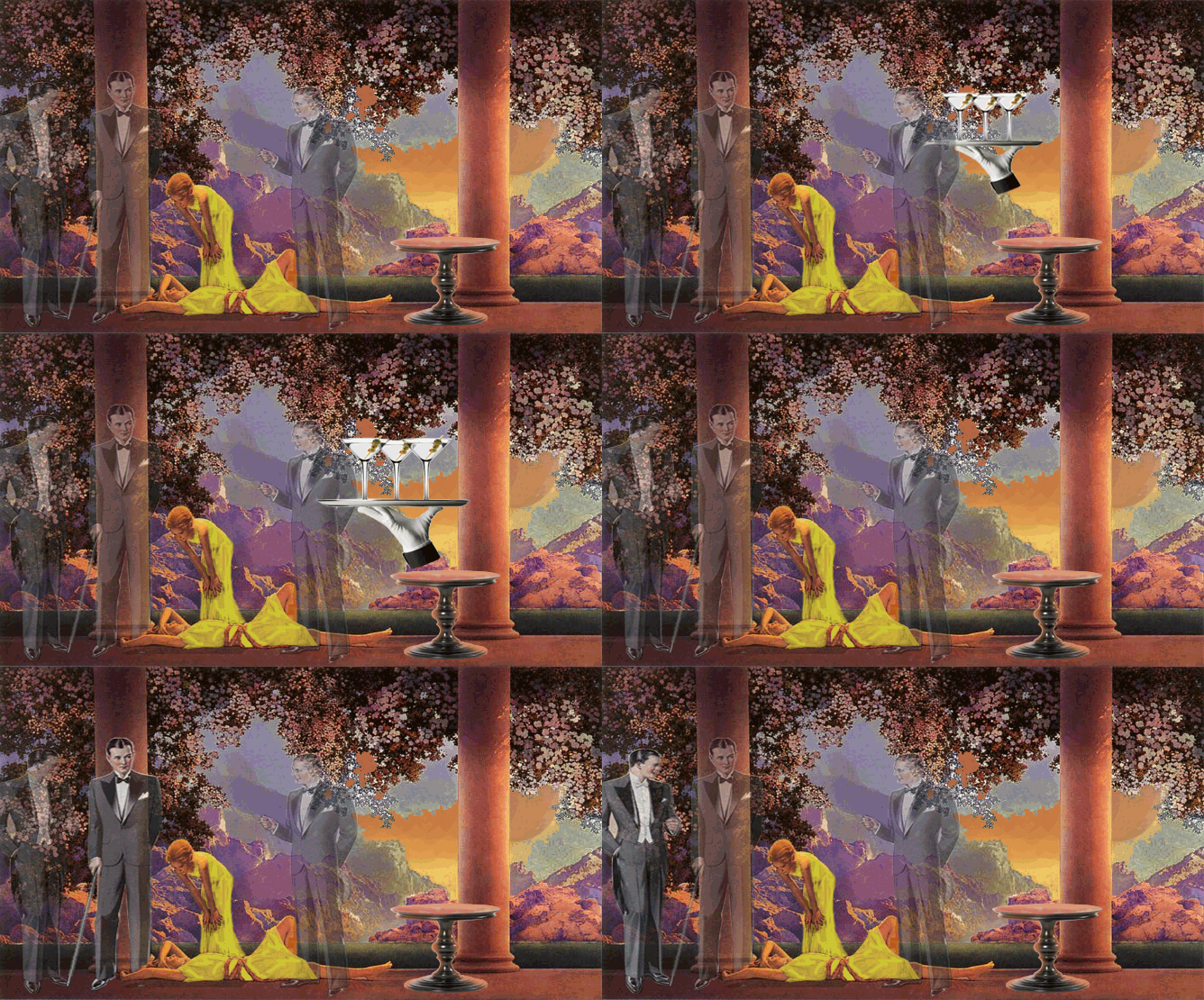
ADDED: Speaking of thrills, here's Chip Ahoy's animation of the "Gatsby" sentence I revealed to be my favorite, 3 days ago:


"A tray of cocktails floated at us through the twilight, and we sat down at a table with the two girls in yellow and three men, each one introduced to us as Mr. Mumble."
Read more ►

Thursday, 24 January 2013

"There was dancing now on the canvas in the garden; old men pushing young girls backward in eternal graceless circles..."

0 comments
"... superior couples holding each other tortuously, fashionably, and keeping in the corners — and a great number of single girls dancing individualistically or relieving the orchestra for a moment of the burden of the banjo or the traps."

Tortuously, fashionably... on the canvas in the garden, keeping in the corners (of the canvas)...

So there's a big square of canvas, maybe on top of the grass, that makes a dance floor, and the couples, with the women going backwards, don't overstep the boundary, whether they're young and pushed by old men or part of a couple of superior dancers. And then there are the females who dance alone. Individualistically or... what? They are bending over the knees of the drummers in the orchestra and allowing themselves to be strummed or beaten upon like a banjo or a drum. Or do you think they oust the band-member and do some drumming or strumming themselves? I'm thinking the latter. But the first image I got from today's "Great Gatsby" sentence was of single ladies becoming the instruments, offering up their voluptuous buttocks as a substitute for conventional instruments. On reflection, I merely see them grabbing an instrument and pretending to be a member of the band.
Read more ►

Wednesday, 23 January 2013

"A tray of cocktails floated at us through the twilight, and we sat down at a table with the two girls in yellow and three men, each one introduced to us as Mr. Mumble."

0 comments
For some reason, that's been my official favorite "Great Gatsby" sentence for a long, long time. I thought I'd bring it out today after getting unreasonably angry at yesterday's "Great Gatsby" sentence (here in our Gatsby project of looking at one "Great Gatsby" sentence each day in absurd isolation). You remember, the crowded hams and the salads of harlequin designs. People said to me, Althouse, you are wrong, this is a perfectly wonderful sentence, it describes sumputuousness and sensuousness. Sumptuousness! I was contemptuous of all this you-us-ness. I said:
1. Any hack writer can use a lot of words and create a picture of a "sumptuous" feast.

2. I'm a reader, a consumer of the words, not of the food itself, so it's not like I'm getting a lot to eat here.

3. "Sumptuousness" seems like a corny idea, like something from a Harlequin (!) romance, especially in the effort to make it seem to refer to sexuality.

4. I'm not getting enough of an elite vibe from the food choices. They seem rather awful. It really does make me feel like it's Thanksgiving at Mom's, not a glorious affair at Gatsby's. Crowded hams! Could ya scootch over, Mom?
Then betamax3000 came in with sharp analysis attributed to Naked Advertisement Copywriter Robot:
Naked Advertisement Copywriter Robot has analyzed sentence and determined an 8.6 correlation with:

Appleby's

Suggested improvement: addition of the word "drizzled."
And so forth.  And that put me in a cheerful mood and prompted me to whip out the official Althouse favorite sentence. Three men, each one introduced to us as Mr. Mumble. I love that. After reading that, you feel like taking an oath never to say anything as banal as: I was introduced to three men, but I didn't catch a single name. Or: Someone introduced us to three men, but the sound quality in the room was such that they might as well all have been named Mr. Mumble. No, you realize, from now on, I must remember to simply assert that the men were introduced as Mr. Mumble. Let the reader lag for a quarter of a second and imagine that could be their names and then get it. Readers are quick. They get this comic, surreal accuracy.

Similarly surreal, the tray of cocktails floated at us through the twilight. Don't bother us with the human being carrying the tray. No one thinks there's some magic floating tray. We get it, and we feel woozy with cocktails, so that it's no wonder every man is Mr. Mumble and every woman is a swatch of color — yellow, in the twilight.
Read more ►

Tuesday, 22 January 2013

"On buffet tables, garnished with glistening hors d’œuvre, spiced baked hams crowded against salads of harlequin designs and pastry pigs and turkeys bewitched to a dark gold."

0 comments
That's today's sentence from "The Great Gatsby" (in the practically inexplicable Gatsby project).

I must say this sentence almost makes me angry, and I'm going to calm myself by diagramming it...
hams | crowded
Okay. That's it! That's the action in this sentence. Hams crowded. Got that?

Another calming method I use when ingesting a Gatsby sentence is: Look for the light. Or: Look for the interplay of light and darkness. (I was just explaining that yesterday.)

In today's sentence, we've got "glistening" for the light (located in the hors d’œuvre), and "bewitched to a dark gold" for the darkness. It's interestingly mysterious that the darkness gets to be gold — a metal that normally is seen as glistening, especially when compared to hors d’œuvre, which... WTF?... are they greasy? Is there a spotlight aimed at them? It's also interesting that there's some bewitching going on, but that just seems to be a goofball way of referring to cooking, the cooking of turkeys and pastry pigs. Now, you know, about 9 days ago, I got all bent out of shape over F. Scott calling pork pig. But here it's quite possible that he's not talking about some cut of pork bewitched to a dark gold, but something pastry (with pork) molded into the shape of a pig.


So I'm not going to let that get my...


Are we through yet? Or is something in this insane undertaking requiring me to help you come to terms with the "salads of harlequin designs"? I found some crazy-ass salads Googling "harlequin salad." Like:
1 can of peas
1 can of sliced beets, diced
1/2 cup Miracle Whip
1 chopped onion (optional)

Dice beets and onions and mix all together and refrigerate until cold. I usually quadruple the recipe because it goes fast.
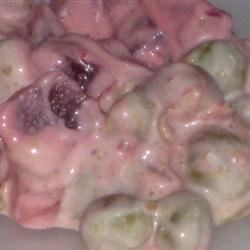
And here's a photograph of something called "Mom Dill's Harlequin Salad":


But we're looking for salads of harlequin designs, and I'm sorry, but there's just no design there. Mom and her ilk are simply using the word "harlequin" to mean multicolored. Harlequin design has got to refer to a much more distinctive diamond shape pattern typical of the Commedia dell'Arte character. Like this:


So I'm picturing some mound of edible material with criss-crossing strips of pimento. Ah! Here: "Fancy Salads of the Big Hotels." That book is from 1921, one year before the events in "The Great Gatsby" are supposed to take place. And here's Robert Salad:
Place two slices of tomato on half a heart of romaine, and on top place two rings of green pepper. Lay a slice of hard boiled eggs in each of the rings and decorate with diamond shaped dice of pimento.
I know. It's really no less disgusting than Mom's concoction. But were we supposed to be licking our chops over this? It's a sentence read in isolation, but I'm guessing we were supposed to think this spread was extravagant and yet... we're happy to stay home with Mom and her ilk after the 4 buckets of Miracle Whip with canned goods have disappeared, down the various household gullets.

Bewitching!
Read more ►

Monday, 21 January 2013

"Her face, above a spotted dress of dark blue crêpe-de-chine, contained no facet or gleam of beauty..."

0 comments
"... but there was an immediately perceptible vitality about her as if the nerves of her body were continually smouldering."

"The Great Gatsby" is flowing with light and darkness, we've seen time and again in this Gatsby project (where we isolate our sentence of the day and have at it). We can almost always begin with the question: Where is the light? And if not where is the light then: Where is the energy that is like light? Some sentences are just light and darkness chasing each other around. Sometimes we get an overwhelming darkness, but there's a play of light.

Today we have a description of a woman, whose face and body each has its own separate claws clause. There's her face above a spotted dress of dark blue crêpe-de-chine. So the dress, the inanimate thing is the overwhelming darkness. The face, being "above," seems detached...


It's devoid of light — no gleam. None of the gleam that would be beauty. No facet...


So forget that face. How about the body under the dress — the dark, spotted dress?


Here, we find the energy, but it's not light. It's fire. Under the dark dress, there is vitality. It's perceptible, as if we're seeing through the spotted dress down into her nerves, her slowly burning — smouldering — nerves.
Read more ►

Friday, 18 January 2013

"Her expression was curiously familiar — it was an expression I had often seen on women’s faces...

0 comments
"... but on Myrtle Wilson’s face it seemed purposeless and inexplicable until I realized that her eyes, wide with jealous terror, were fixed not on Tom, but on Jordan Baker, whom she took to be his wife."

Today's Gatsby sentence — we read one sentence from "The Great Gatsby" every day here on the Althouse blog — is very long, one clause after another, and yet, it doesn't tumble all out of control. We get it.

It's a sentence about an expression on a woman's face, a very common and utterly insipid expression, yet obviously very disturbing for the woman herself, even as we are deprived of any reason to feel for her. She's not even right about what she thinks she sees.
Read more ►

Wednesday, 16 January 2013

"A breeze blew through the room, blew curtains in at one end and out the other like pale flags..."

0 comments
"... twisting them up toward the frosted wedding-cake of the ceiling, and then rippled over the wine-colored rug, making a shadow on it as wind does on the sea."

More wind, water, and light. We've gotten used to it here in this windy, watery, light-and-dark world of the Gatsby project. This sentence seems like a made up imitation of a sentence from "The Great Gatsby," but I assure you it's there.

All that's happening here is a breeze blowing through the room, but we have a traffic jam of metaphor: flags, wedding-cake, and wine. What are we supposed to see here? And good lord, it's a room. Must we really believe that something cataclysmic is going on when a breeze blows the curtains? Maybe we should. Maybe all sorts of crazy stuff happens in a room and it is like an epic storm at sea.

The wine-colored rug stands in for the sea, so I have to assume that we're supposed to think of the  "wine-dark sea" we hear about, repeatedly, in Homer's Iliad and Odyssey. It is an epic, contained in that room. The dark shadows ripple, turning the wine-rug into sea, so I guess the ceiling is the sky. I guess that's a fancy white ceiling with all sorts of fancy woodwork, resembling the ornamentation on a wedding cake. The curtains swirling around the wedding-cake textures are cloud-like, I suppose. So fabric and wood make the erstwhile cake-like ceiling into stormy sky and curtain-driven shadows make the otherwise wine-like carpet into roiling sea.

It's a tempestuous room, containing a marriage. Raise a toast and let's feed each other cake.
Read more ►

Tuesday, 15 January 2013

"He lit Daisy’s cigarette from a trembling match, and sat down with her on a couch far across the room..."

0 comments
"... where there was no light save what the gleaming floor bounced in from the hall."

Today's sentence, in the Gatsby project, where we read one sentence from "The Great Gatsby" each day.

What jumps out — bounces out — at me here is the dual light action: the lighting of the cigarette and the light bouncing in from the hall. The sources of light: 1. a trembling match, and 2. a gleaming floor. Both light sources go with -ing words. The light that has to do with a person doing something is trembling, and the light whose action has no human agent gleams and bounces. There's a big contrast between the emotional content of the 2 lights, the one — trembling — in the dark, in the intimate relationship between the man's hand and the woman's mouth, and the other — bouncing — off the floor from a shiny, bright place.

I've called attention to the light action that is human and that is not, but in this... light!, it's important to see what is not said. We don't get "trembling hand." We get "trembling match." The man is there in the "He" — "He lit" — but there's something cagey or removed about saying it's the match that's trembling. A trembling hand is only implied. That makes the lights more inanimate, but it also heightens the picture of light. We see the burning match, not the hand. And that puts the man-woman intimacy more deeply in the dark. They get as deep into the dark room and away from the light as they can. Good reason to tremble.
Read more ►

Monday, 14 January 2013

"There is no confusion like the confusion of a simple mind, and as we drove away Tom was feeling the hot whips of panic."

0 comments
There are different minds and different confusions, and perhaps each is unlike every other. That possibility is not excluded by the assertion that "There is no confusion like the confusion of a simple mind." All we know is that we are looking at the specific confusion that is the confusion of a simple mind, the unavoidable inference that Tom has a simple mind, and that the manifestation of this specific form of confusion feels like hot whips of panic.

This is our Gatsby sentence today. Do you identify with Tom? Do you panic when confused? Do you experience panic as hot whips? I think it's more likely that you don't identify with Tom. He's driving away from whatever is confusing him. (How about figuring things out, loser?) He's too simple to do anything but run and panic. And he's flogged absurdly by his own flaring inability to deal with anything at all challenging.

Yes, drive away, Tom, you pathetic little man.
Read more ►

Sunday, 13 January 2013

"I knew the other clerks and young bond-salesmen by their first names, and lunched with them in dark, crowded restaurants on little pig sausages and mashed potatoes and coffee."

0 comments
It means something that F. Scott Fitzgerald wrote "pig" instead of "pork." I think about how George Harrison sang about piggies, the bigger piggies, "in their starched white shirts... stirring up the dirt" as well as "the little piggies... crawling in the dirt." (He stirred up Charles Manson to deliver "a damned good whacking.")

Life was "getting worse" for the little piggies, while, by contrast, the bigger piggies "always had clean shirts." Now, I'm not going to veer off into the topic of The Great — big pig — Gatsby's shirts. You know if you've read "The Great Gatsby" or seen the movie that a huge to-do is made at one point about how many beautiful shirts Gatsby had.

But here in this Gatsby project, we look at one sentence in isolation. That way, everyone's on the same footing. You don't have the little readers and the bigger readers. Life isn't getting worse for some of us and just fine for others. We gather here, in the daily post, to consume one sentence, so let's lunch.

Let's know each other by first names. Here we are equals. We have all read the sentence, and we can all very well speak out about it. Here, we actively exclude extrinsic evidence. About the book, I mean. We're free to drag in anything else, such as The Beatles, as betamax3000 did so well in yesterday's Gatsby thread, the one about warm human magic.

So pig, then. Pig, not pork. Which makes us think that the clerks and bond-salesmen are little piggies. The men eating humble food — all the humbler for saying pig, not pork — in a dark, crowded place. A pigsty? Our narrator is crammed in close quarters with them as he chows down. He's on familiar terms with them: He calls them by their first names. He's a member of the herd of little piggies.

Did you notice the words are right there one after the other: little pig? As a competent and tolerant reader, you can tell it's the sausages and not the pigs that are supposed to be little, and as a picky reader, you might say it's bad writing to permit that ambiguity to survive the final draft. But maybe the writer wanted you to see little pig. And the bigger question is why insert the pig at all? We'd presume that sausages were pork. Obviously, Fitzgerald wants us to think about pigs and think about the men as pigs. He wasn't as blunt as Mr. Harrison, but he was calling these guys pigs.

Another reason to throw pig in there, permitting the ambiguity, is to call the sausages little without being too aggressively Freudian about saying little sausages and making us think too quickly — before we'd noticed all these other things — of pricks.

ADDED: Meade, helping me proofread, questioned "herd" as the proper collective term for pigs. I know there are some other options, but I like it because it evokes Jesus:
Some distance from them a large herd of pigs was feeding. The demons begged Jesus, “If you drive us out, send us into the herd of pigs.” He said to them, “Go!” So they came out and went into the pigs, and the whole herd rushed down the steep bank into the lake and died in the water. Those tending the pigs ran off, went into the town and reported all this, including what had happened to the demon-possessed men. Then the whole town went out to meet Jesus. And when they saw him, they pleaded with him to leave their region.
Read more ►

"That's how you laughed in the middle of the night."

0 comments
Said Meade, and I said: "Then Chip Ahoy must have been in my dream."

Because I was just reading his comment: "Melody and Rose broke up the Sweedish contractors and threw change in the tip jar and put on her warm magic apron."

And I laughed not because that is nonsense, but because it's a quite brilliant contribution to a conversation that was pretty far along at that point, including betamax3000's extended interpretation of "The White Album." Beta had said:
Like the White Album perhaps Althouse is telling us there are secret messages to be found, backwards.

"Sweetly up broke voice, her rose melody."

"Upon magic human warm her of little."

"Out tipped change."
It all began with a sentence from "The Great Gatsby," which was about — not a woman laughing — a woman singing. But women laugh all the time in "The Great Gatsby." For example: "She looked at me and laughed pointlessly."

"These 'Gatsby' posts are becoming the new café around here" — "café" posts are open threads  — I say as I drink my coffee and contemplate today's Gatsby sentence, which I'd said will be "I knew the other clerks and young bond-salesmen by their first names, and lunched with them in dark, crowded restaurants on little pig sausages and mashed potatoes and coffee."

I picked that sentence after searching my Kindle copy of "Gatsby" for "potato" after betamax3000 said:
Yesterday was "gulp down the incomparable milk of wonder," today is "tipped out a little of her warm human magic." Is it getting hot in here or is it just me?
And that was funny, because — before getting out of bed this morning — I'd been toying with the idea of saying: In that "Melody rose" sentence, Fitzgerald intended us to think of semen when we read about "warm human magic" that tipped out of the vessel that is the woman.
 

And betamax added:
My God: if we get to the sentence involving Daisy, the potato and the gardener I just don't know what is going to happen.
Which is what had me looking for "potato" in "Gatsby," not finding it, and suspecting that betamax was making a canny reference to "Lady Chatterly's Lover." I buy "Lady Chatterly's Lover" in Kindle just so I can search for "potato"! My literary pursuits are a tad — a tot — bizarre. I find:
"No; my heart's as numb as a potato, my penis droops and never lifts its head up, I dare rather cut him clean off than say 'shit!' in front of my mother or my aunt... they are real ladies, mind you; and I'm not really intelligent, I'm only a 'mental-lifer.'"
And:
"I don't want to fuck you at all. My heart's as cold as cold potatoes just now."
Read more ►

Saturday, 12 January 2013

"When the melody rose, her voice broke up sweetly, following it, in a way contralto voices have, and each change tipped out a little of her warm human magic upon the air."

0 comments
Today's Gatsby sentence, describing singing, has us picturing the woman as a vessel containing warm human magic. Because she's a contralto, her voice needs to break as it reaches for the high notes, and in these breaks, there's a tipping that spills out a little of her contents — warm human magic. The magic spills upon the air. There's rising and falling: The melody rises and the voice along with it, and the magic falls out, upon the air. It's very light, this human magic, to be on top of air. It is the sweet, warm liquid of the woman tipping out.
Read more ►

Friday, 11 January 2013

"Out of the corner of his eye Gatsby saw that the blocks of the sidewalks really formed a ladder and mounted to a secret place above the trees..."

0 comments
"... he could climb to it, if he climbed alone, and once there he could suck on the pap of life, gulp down the incomparable milk of wonder."

This is some crazy surrealism, in our Gatsby sentence today. (In the Gatsby project, we look, each day, at a single isolated sentence from "The Great Gatsby.") But let's settle down and understand what we are looking at. It's Gatsby's visual perspective. "Out of the corner of his eye" cues us that it's subjective and distorted. He's looking at the sidewalk and the perception is that it looks like a ladder. We're told that it really is a ladder, but we know that's not true. It really is a sidewalk, but to Gatsby subjectively, it's a ladder. Gatsby imagines himself climbing somewhere. Mounting. It's a secret place.

"... he could climb to it, if he climbed alone..." — I want to say that the illusion only remains intact if Gatsby is alone. And the vision, if he can hold himself within it, is of climbing that ladder up through the trees and then finally coming alive.

It's a vision of being born, just by walking down that sidewalk. And then he could be alive. He'd suck on the maternal breast, the pap of life. He wants to gulp it down — that incomparable milk of wonder.

He's just a man on a sidewalk. There's no ladder. He's already born and living in real life. But somehow it seems that real life is out there, unreachable. But if only you could get there, above the trees, you would drink it down. Incomparable! Wonderful!

***
Everybody's looking 4 the ladder
Everybody wants salvation of the soul
ADDED: I can see in the comments that some readers really do have trouble mentally picturing a sidewalk looking like a ladder. I don't want to get too laborious and pedantic with these Gatsby posts, but the lines on the sidewalk correspond to the rungs of a ladder. The path stretched out ahead, even when it's flat, seems to go upward. Look at a photograph of a sidewalk. Further down the road is higher in the picture. If trees line the sidewalk, then the "ladder" appears to climb up into the trees as it disappears behind the foliage. I called the sentence "crazy surrealism," but Gatsby isn't hallucinating. He's seeing an optical illusion.
Read more ►

Thursday, 10 January 2013

"A breeze stirred the gray haze of Daisy’s fur collar."

0 comments
Very little going on in the action here. A tiny wind creates a bit of motion in a small subsection of the lady's clothing. But poetically — in the sound and look of the words — this is a very happening sentence.

Breeze and haze go together, with their z's. Gray rhymes with the beginning of haze, and haze rhymes with the beginning of Daisy. Gray... hay... day... Gray heyday.  

Stir and fur rhyme, and there's a faint echo of that rhyme at the end of collar.

We saw the wind ruffling Daisy's clothes one other time in this "Great Gatsby" project, but we can't talk about that now, because the idea is to restrict ourselves, each day, to one sentence, in isolation.
Read more ►

"Nobody ever became a writer just by wanting to be one. If you have anything to say..."

0 comments
"... anything you feel nobody has ever said before, you have got to feel it so desperately that you will find some way to say it that nobody has ever found before, so that the thing you have to say and the way of saying it blend as one matter — as indissolubly as if they were conceived together."
Let me preach again for one moment: I mean that what you have felt and thought will by itself invent a new style so that when people talk about style they are always a little astonished at the newness of it, because they think that is only style that they are talking about, when what they are talking about is the attempt to express a new idea with such force that it will have the originality of the thought.
ADDED: For comparison: "Something that you feel will find its own form."
Read more ►

Wednesday, 9 January 2013

"I suppose the latest thing is to sit back and let Mr. Nobody from Nowhere make love to your wife."

0 comments
I wonder if "the latest thing" was a new expression back in 1922 when F. Scott Fitzgerald started writing "The Great Gatsby." Was "the latest thing" the latest thing, that is, new slang? If so, it's even funnier to see it used sarcastically like this. What a crazy trend it would be — a fashionable sex kink?

But then maybe there actually is such a trend these days. The "cuckold fetish" is a routine subject in Dan Savage's sex advice column, e.g., "Fuck My Wife, Please!"

Anyway, the sarcasm in today's "Gatsby" sentence is sublime. There's "the latest thing" and "sit back and let" and the marvelous "Mr. Nobody from Nowhere" — all of which only become funny — painfully funny — when you get to the tragically pedestrian phrase "make love to your wife."

It's also amusing that the problem is less that somebody is fucking his wife than that a nobody is fucking his wife. Mr. Nobody from Nowhere, who — if you violated the rules of the Gatsby project and go beyond the sentence — is the (supposedly) great Mr. Gatsby.

IN THE COMMENTS: Bill Harshaw uses The Great Google to show that "the latest thing" was, in fact, a well-established expression. The casual use of the word "thing" seems like modern slang. There are a lot of common phrases like "the thing to do," "a [fill in the blank] thing," "it's my thing," and "the real thing" that seem like things people would have said 100 years ago.

ALSO IN THE COMMENTS: Much discussion about how far Mr. Nobody really got: What did "make love" mean in the 1920s?
Read more ►

Tuesday, 8 January 2013

"Gatsby, pale as death, with his hands plunged like weights in his coat pockets, was standing in a puddle of water glaring tragically into my eyes."

0 comments
The most interesting thing about today's "Gatsby" sentence is the use of plunged for the action of the hands into the pockets, when the feet are in a puddle of water. A puddle isn't deep, and Gatsby is just standing in the puddle. He can't be plunged into a mere puddle, but then again, his pockets are not bodies of water, so the plunging into the pockets is metaphorical.

The puddle is shallow and the pockets are not deep water, and Gatsby's hands aren't really weights. They're just like weights. But if you were weighted and plunged into deep water, you'd be in great danger of dying, and, indeed, Gatsby is pale as death. Drowning could be called a tragedy, and Gatsby is glaring tragically into the narrator's eyes.

Maybe you think this sentence is overwritten. Pale as death is a cliché and it's sort of redundant with glaring tragically.  Adverb adversaries would say you don't need tragically when you've already got glaring. Verbosity prigs might say if the narrator is able to see that Gatsby is glaring, it's tedious to go to the trouble to tack on into my eyes. And into my eyes is kind of a slow way to coast to an ending when you're trying to be this dramatic, what with death and weights and tragically dragging us down.

But maybe if we could escape from this isolated sentence — which we can't, in the Gatsby project as arbitrarily defined by me — we would see reason behind the seemingly weak into my eyes. Gatsby is desperate for something that must come, very specifically, from the narrator. Save me!

AND: Did "a puddle of water glaring tragically into my eyes" bother you?
Read more ►
 

Copyright © Diet Althouse Design by O Pregador | Blogger Theme by Blogger Template de luxo | Powered by Blogger