Thursday, 24 January 2013
Tuesday, 22 January 2013
"On buffet tables, garnished with glistening hors d’œuvre, spiced baked hams crowded against salads of harlequin designs and pastry pigs and turkeys bewitched to a dark gold."
That's today's sentence from "The Great Gatsby" (in the practically inexplicable Gatsby project).
I must say this sentence almost makes me angry, and I'm going to calm myself by diagramming it...
Another calming method I use when ingesting a Gatsby sentence is: Look for the light. Or: Look for the interplay of light and darkness. (I was just explaining that yesterday.)
In today's sentence, we've got "glistening" for the light (located in the hors d’œuvre), and "bewitched to a dark gold" for the darkness. It's interestingly mysterious that the darkness gets to be gold — a metal that normally is seen as glistening, especially when compared to hors d’œuvre, which... WTF?... are they greasy? Is there a spotlight aimed at them? It's also interesting that there's some bewitching going on, but that just seems to be a goofball way of referring to cooking, the cooking of turkeys and pastry pigs. Now, you know, about 9 days ago, I got all bent out of shape over F. Scott calling pork pig. But here it's quite possible that he's not talking about some cut of pork bewitched to a dark gold, but something pastry (with pork) molded into the shape of a pig.

So I'm not going to let that get my...

Are we through yet? Or is something in this insane undertaking requiring me to help you come to terms with the "salads of harlequin designs"? I found some crazy-ass salads Googling "harlequin salad." Like:

But we're looking for salads of harlequin designs, and I'm sorry, but there's just no design there. Mom and her ilk are simply using the word "harlequin" to mean multicolored. Harlequin design has got to refer to a much more distinctive diamond shape pattern typical of the Commedia dell'Arte character. Like this:

So I'm picturing some mound of edible material with criss-crossing strips of pimento. Ah! Here: "Fancy Salads of the Big Hotels." That book is from 1921, one year before the events in "The Great Gatsby" are supposed to take place. And here's Robert Salad:
Bewitching!
Read more ►
I must say this sentence almost makes me angry, and I'm going to calm myself by diagramming it...
hams | crowdedOkay. That's it! That's the action in this sentence. Hams crowded. Got that?
Another calming method I use when ingesting a Gatsby sentence is: Look for the light. Or: Look for the interplay of light and darkness. (I was just explaining that yesterday.)
In today's sentence, we've got "glistening" for the light (located in the hors d’œuvre), and "bewitched to a dark gold" for the darkness. It's interestingly mysterious that the darkness gets to be gold — a metal that normally is seen as glistening, especially when compared to hors d’œuvre, which... WTF?... are they greasy? Is there a spotlight aimed at them? It's also interesting that there's some bewitching going on, but that just seems to be a goofball way of referring to cooking, the cooking of turkeys and pastry pigs. Now, you know, about 9 days ago, I got all bent out of shape over F. Scott calling pork pig. But here it's quite possible that he's not talking about some cut of pork bewitched to a dark gold, but something pastry (with pork) molded into the shape of a pig.

So I'm not going to let that get my...

Are we through yet? Or is something in this insane undertaking requiring me to help you come to terms with the "salads of harlequin designs"? I found some crazy-ass salads Googling "harlequin salad." Like:
1 can of peasAnd here's a photograph of something called "Mom Dill's Harlequin Salad":
1 can of sliced beets, diced
1/2 cup Miracle Whip
1 chopped onion (optional)
Dice beets and onions and mix all together and refrigerate until cold. I usually quadruple the recipe because it goes fast.
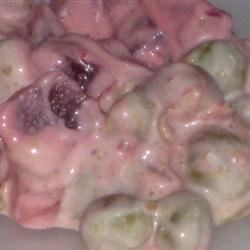
But we're looking for salads of harlequin designs, and I'm sorry, but there's just no design there. Mom and her ilk are simply using the word "harlequin" to mean multicolored. Harlequin design has got to refer to a much more distinctive diamond shape pattern typical of the Commedia dell'Arte character. Like this:

So I'm picturing some mound of edible material with criss-crossing strips of pimento. Ah! Here: "Fancy Salads of the Big Hotels." That book is from 1921, one year before the events in "The Great Gatsby" are supposed to take place. And here's Robert Salad:
Place two slices of tomato on half a heart of romaine, and on top place two rings of green pepper. Lay a slice of hard boiled eggs in each of the rings and decorate with diamond shaped dice of pimento.I know. It's really no less disgusting than Mom's concoction. But were we supposed to be licking our chops over this? It's a sentence read in isolation, but I'm guessing we were supposed to think this spread was extravagant and yet... we're happy to stay home with Mom and her ilk after the 4 buckets of Miracle Whip with canned goods have disappeared, down the various household gullets.
Bewitching!

Tuesday, 15 January 2013
"The pollen piece looks like a yellow painting... but it’s much, much more."
"It’s not a yellow pigment, which is very important for me. It’s the potential beginning of millions of plants. It’s the semen for the plants. And this I was interested in. It has an appearance, maybe, like a painting, but the sun is not a round ball. It’s much, much more. The sky is not a blue painting. For me, these things were somehow very important. I would have stayed as a doctor, if art was only about this color or that color."
Read more ►
Monday, 14 January 2013
"Must you always be out in that ghastly clown suit, running around annoying people?"
Says Pretty Alice to the Harlequin in Harlan Ellison's "Repent Harlequin!' Said The Ticktockman," which I read on the urging of commenter Icepick because of the way it reflected on the recent news stories about Aaron Swartz, David Gregory, and the Boston ban on drinking games.
I downloaded this Orson Scott Card collection — "Masterpieces: The Best Science Fiction of the 20th Century" — which included "Repent Harlequin," because I wanted to understand this harlequin/ticktockman distinction, and lo and behold here's the harlequin — actually, what do you expect? he's a harlequin — wearing a clown suit, when just 5 days ago, the bloggism of the day was clown suits. We were pimping clown suits.

It's weird how these themes seem to coagulate on their own.
IN THE COMMENTS: Astro said points out that my Picasso clown isn't a harlequin. I need to be better about specifying the Commedia dell'arte characters. Here's a Picasso harlequin (on the right):

Read more ►
I downloaded this Orson Scott Card collection — "Masterpieces: The Best Science Fiction of the 20th Century" — which included "Repent Harlequin," because I wanted to understand this harlequin/ticktockman distinction, and lo and behold here's the harlequin — actually, what do you expect? he's a harlequin — wearing a clown suit, when just 5 days ago, the bloggism of the day was clown suits. We were pimping clown suits.
It's weird how these themes seem to coagulate on their own.
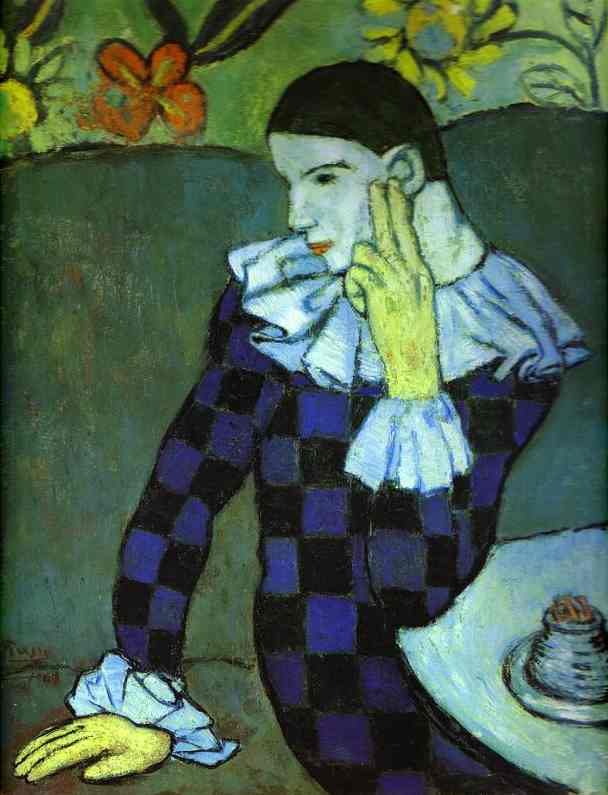
IN THE COMMENTS: Astro said points out that my Picasso clown isn't a harlequin. I need to be better about specifying the Commedia dell'arte characters. Here's a Picasso harlequin (on the right):

Friday, 11 January 2013
"Some time ago a stranger asked me to make his portrait... So I did. I sent him the image and I never heard back from him again since that moment."
"Not long ago I saw one painting and I felt that it was very familiar to me. And then I got it — It was a copy of my photo! I did a little research on that and it seem that the guy who [copied] it is quite well known around... His name is Vincent Van Gogh or something..."
(More here.)
Read more ►
(More here.)
"Artist found burned to death on top of his masterpiece."
"Artist Jorge Selaron may have taken his own life by setting himself on fire on the very steps of his masterpiece, a brilliantly colored public staircase that became a symbol of Rio de Janeiro..."
Read more ►
The stairs, his life's work, were declared city patrimony in 2005, when Selaron was made an honorary carioca, as Rio residents are called. The steps have been featured in Snoop Dogg's "Beautiful" and U2's "Walk On" music videos, as well as part of the video that Brazil made for their 2016 Olympic bid.Here's the Snoop Dogg video. Here's the U2.
Friday, 4 January 2013
"I don’t know whether this world has a meaning that transcends it."
"But I know that I cannot know that meaning and that it is impossible for me just now to know it."

Today, the "History of" project brings us to...
Algeria, where human beings have lived for at least 1.8 million years. There are prehistoric rock paintings in the Tassili n'Ajjer range. Like this:

The indigenous people have been called Berbers since 4000 BC, and they have been joined over the years by invaders of the Phoenician, Roman, Vandal, Byzantine, Arab, Turkish, and French kind.

Read more ►
Today, the "History of" project brings us to...
Algeria, where human beings have lived for at least 1.8 million years. There are prehistoric rock paintings in the Tassili n'Ajjer range. Like this:

The indigenous people have been called Berbers since 4000 BC, and they have been joined over the years by invaders of the Phoenician, Roman, Vandal, Byzantine, Arab, Turkish, and French kind.
Berber territory was annexed by the Roman Empire in AD 24. Increases in urbanization and in the area under cultivation during Roman rule caused wholesale dislocations of Berber society, and Berber opposition to the Roman presence was nearly constant....Colonization by the French began in 1830.
Christianity arrived in the 2nd century AD. By the end of the 4th century, the settled areas had become Christianized, and some Berber tribes had converted en masse....
The 8th and 11th centuries AD, brought Islam and the Arabic language....
In the central Maghrib, the Abdalwadid founded a dynasty at Tlemcen in Algeria. For more than 300 years, until the region came under Ottoman suzerainty in the 16th century, the Zayanids kept a tenuous hold in the central Maghrib. Many coastal cities asserted their autonomy as municipal republics governed by merchant oligarchies, tribal chieftains from the surrounding countryside, or the privateers who operated out of their ports. Nonetheless, Tlemcen, the “pearl of the Maghrib,” prospered as a commercial center.
The final triumph of the 700-year Christian reconquest of Spain was marked by the fall of Granada in 1492. Christian Spain imposed its influence on the Maghrib coast by constructing fortified outposts and collecting tribute. But Spain never sought to extend its North African conquests much beyond a few modest enclaves. Privateering was an age-old practice in the Mediterranean, and North African rulers engaged in it increasingly in the late 16th and early 17th centuries because it was so lucrative. Algeria became the privateering city-state par excellence.....
Algeria and surrounding areas, collectively known as the Barbary States, were responsible for piracy in the Mediterranean Sea, as well as the enslaving of Christians, actions which brought them into the First and Second Barbary War with the United States of America.
Viewed by the Europeans with condescension at best and contempt at worst, the Algerians endured 132 years of colonial subjugation. From 1856, native Muslims and Jews were viewed as French subjects, but not French citizens.Abdelaziz Bouteflika became president in 1999 and "concentrated on restoring security and stability." He remains president to this day.
However, in 1865, Napoleon III allowed them to apply for full French citizenship, a measure that few took, since it involved renouncing the right to be governed by sharia law in personal matters, and was considered a kind of apostasy; in 1870, French citizenship was made automatic for Jewish natives, a move which largely angered the Muslims, who began to consider the Jews as the accomplices of the colonial power. Nonetheless, this period saw progress in health, some infrastructures, and the overall expansion of the economy of Algeria, as well as the formation of new social classes, which, after exposure to ideas of equality and political liberty, would help propel the country to independence. During the years of French domination, the struggles to survive, to co-exist, to gain equality, and to achieve independence shaped a large part of the Algerian national identity....
A new generation of Islamic leadership emerged in Algeria at the time of World War I and grew to maturity during the 1920s and 1930s. Various groups were formed in opposition to French rule....
The Algerian War of Independence (1954–1962), brutal and long, was the most recent major turning point in the country's history. Although often fratricidal, it ultimately united Algerians and seared the value of independence and the philosophy of anticolonialism into the national consciousness....
Between 350,000 and 1 million Algerians are estimated to have died during the war, and more than 2 million, out of a total Muslim population of 9 or 10 million, were made into refugees or forcibly relocated into government-controlled camps. Much of the countryside and agriculture was devastated, along with the modern economy, which had been dominated by urban European settlers (the pied-noirs). French sources estimated that at least 70,000 Muslim civilians were killed or abducted and presumed killed, by the [Front de Libération Nationale] during the Algerian War. Citizens of European ethnicity... and Jews were also subjected to ethnic cleansing. These nearly one million people of mostly French descent were forced to flee the country at independence due to the unbridgeable rifts opened by the civil war and threats from units of the victorious FLN; along with them fled Algerians of Jewish descent and those Muslim Algerians who had supported a French Algeria (harkis). 30-150,000 pro-French Muslims were also allegedly killed in Algeria by FLN in post-war reprisals....
On 19 June 1965, Houari Boumédienne deposed Ahmed Ben Bella in a military coup d'état that was both swift and bloodless....
Boumédienne’s death on December 27, 1978 set off a struggle within the FLN to choose a successor....
After the violent 1988 October Riots, a new constitution was adopted in 1989 that allowed the formation of political associations other than the FLN....
Among the scores of parties that sprang up under the new constitution, the militant Islamic Salvation Front (FIS) was the most successful....
In 1996 a referendum introduced changes to the constitution, enhancing presidential powers and banning Islamist parties.

Subscribe to:
Comments (Atom)

