Monday, 28 January 2013

Lorrie Moore is leaving the University of Wisconsin.

0 comments
A sad day for us!

She came here in 1984 — the same year I did — back when "Self-Help" was still a manuscript.
Read more ►

Thursday, 24 January 2013

Purchase of the (yester)day.

0 comments
"Intellectuals and Society": Revised and Expanded Edition [Paperback] Thomas Sowell (Amazon Associates earnings to the blog: $1.06). Maybe we should start a Thomas Sowell book club. Someone near and dear made me happy by sending me this book for Christmas. Thanks to everyone who used the Althouse Amazon portal.
Read more ►

Monday, 21 January 2013

"Going Clear: Scientology, Hollywood, and the Prison of Belief."

0 comments
A new book, given an excellent review in WaPo, here:
“Going Clear” starts with exactly the right questions: “What is it that makes the religion alluring? What do its adherents get out of it? How can seemingly rational people subscribe to beliefs that others find incomprehensible?” And in his early chapters, [Lawrence] Wright implicitly draws parallels between this religion and those with which readers may be more familiar.

Scientology is, in its components, a stew of traditional religious concepts. There’s immortality, transcendence, salvation and ethics. There are rituals as well as ritual punishments. There’s a founder, or a prophet, mediating capital-T truth for the people and transcribing it in books and pamphlets that serve as scripture. All this is wrapped up in a package that, while not recognizably Christian, or Buddhist, or Freudian, or Jungian, or occult, has elements of all.

Wright knows that crazy-seeming religious beliefs and practices are not, in themselves, sinister or evil....
Read more ►

Friday, 18 January 2013

"I always start with physicality when I’m writing as a woman. So I always have a vagina and think about having periods."

0 comments
Said Will Self, who has a new novel, "Umbrella," the title of which is based on the Joyce quote "A brother is as easily forgotten as an umbrella."

By the way, the first appearance of the word "umbrella" in English, according to the OED (not linkable), came in 1611:
T. Coryate Crudities sig. Lv,   Many of them doe carry other fine things.., which they commonly call in the Italian tongue vmbrellaes... These are made of leather something answerable to the forme of a little cannopy & hooped in the inside with diuers little wooden hoopes that extend the vmbrella in a prety large compasse.
That predates the first use of "vagina," which was in 1682:
T. Gibson Anat. Humane Bodies 20   It has passages..for the neck of the Bladder, and in Women for the vagina of the Womb.
The etymology of "vagina" is: "Latin vāgīna sheath, scabbard." The etymology of "umbrella" is: "Italian ombrella and ombrello, < ombra < Latin umbra shade."

Here's Perry Como singing "Let a Smile Be Your Umbrella."

Fill in the blank: Let a smile be your umbrella. Let a _________ be your vagina.
Read more ►

If Sonia Sotomayor's autobiography has nothing at all about law or even politics...

0 comments
... why would anyone read it?
The book, which covers her life prior to becoming a judge, barely says a word about the Constitution and even less about ideology. Yet one doesn't get the sense that politics were scrubbed from the text; it is rather that the topic isn't of much interest to the author.
That's what a good scrubbing job would do. So there's no bad scrubbing job leaving interesting residue.
One wishes she had shared her intellectual interests with us or discussed the books that captured her fancy or influenced her thinking, since she remarks more than once in "My Beloved World" that the library was a refuge for her as a schoolgirl and later at Princeton. Disclosing the names of books that influenced a childhood wouldn't compromise pending or future cases.
Welcome to the post-Bork world — a "beloved" world? — where judges are dutiful, neutral case processors. The very quality that makes a judge the kind of judge we've come to require — post-Bork — will embody a form of expression antithetical to a good memoir.
Read more ►

Thursday, 17 January 2013

"Americans, while occasionally willing to be serfs, have always been obstinate about being peasantry."

0 comments
Think hard. It doesn't really matter — does it? — that this is today's sentence from "The Great Gatsby," another dutiful posting in our Gatsby project, wherein we look at one sentence, out of context, each day. I know the context of that sentence. I know what happened in the story. You can look it up.

It's so tempting to break out of the form of the project and tell you, to go back into the paragraph, even as I want to tempt you out of the book altogether to look at this proposition that Americans are willing — occasionally! — to be serfs but won't accept the notion that they are peasants. What's the difference?!

But I've got to tell you. There was a rich man — not Gatsby — who tried to get the people in the houses around his house to accept having their roofs thatched with straw. He offered to pay their taxes for 5 years if they'd accept this imposition which would have allowed him to have a nice view of a faux-peasant village. They refused, and the rich man, we're told, "went into an immediate decline." And "His children sold his house with the black wreath still on the door." That's how Gatsby got his house. So that's the peasant idea that offends Americans.

But serfs. We are willing to be serfs.
Read more ►

Tuesday, 15 January 2013

"What sort of people were these? What were they talking about? What office did they belong to? K. was living in a free country, after all..."

0 comments
"... everywhere was at peace, all laws were decent and were upheld, who was it who dared accost him in his own home?"

A Kafka quote begins Roger Kimball's op-ed "This Metamorphosis Will Require a Permit/Sandy wrecked our house, but bureaucrats are keeping it broken."

Kimball also quotes Hayek:
[T]he power which a multiple millionaire, who may be my neighbor and perhaps my employer, has over me is very much less than that which the smallest functionnaire possesses who wields the coercive power of the state on whose discretion it depends whether and how I am to be allowed to live or to work.
And Tocqueville:
"[A] network of small, complicated, painstaking, uniform rules"... reduces citizens "to being nothing more than a herd of timid and industrious animals of which the government is the shepherd."
Books:
Franz Kafka, "The Trial"
F.A. Hayek, "The Road to Serfdom"
Alexis de Tocqueville, "Democracy in America"
Roger Kimball, "The Fortunes of Permanence: Culture and Anarchy in an Age of Amnesia"
Read more ►

"There are notes and notes, of course: notes to oneself and notes to others; notes taken, made, jotted, and passed."

0 comments
"Mash, doctor's, suicide, and condolence notes. Field, class, and case notes; notes for general circulation; foot and head notes, notes of hand. But it's the bookish notes that academics care most about, the ones that intervene between the things we read and the things we write."

Geoffrey Nunberg has notes from his notes as a note-taker at a conference on notes.

For [Walter Benjamin], the rise of note-taking signaled the book's reduction into a purely transitional object, "an obsolete mediation between two different filing systems." Everything that matters, he said, could be found in the card boxes of the researcher who wrote it, which the scholar studying it had merely to incorporate in his own card index.
Ha ha. Brilliant. And archaic. Card boxes.
Read more ►

Monday, 14 January 2013

Sotomayor, the college years.

0 comments


One slide in a long, narrated slideshow at NPR.com. I picked that one out because it's so different from the others and from every other photo I've ever seen of Sotomayor. NPR did the article to go with Justice Sotomayor's new autobiography, "My Beloved World."
Read more ►

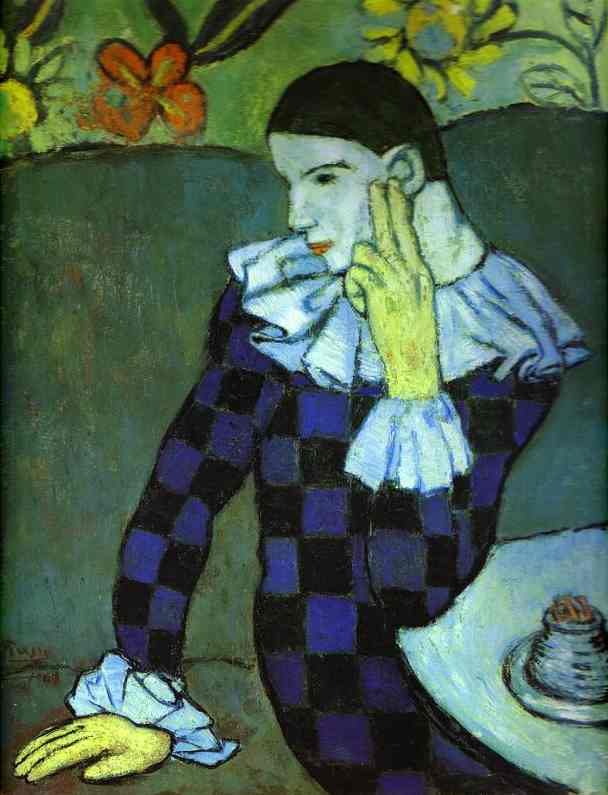
"Must you always be out in that ghastly clown suit, running around annoying people?"

0 comments
Says Pretty Alice to the Harlequin in Harlan Ellison's "Repent Harlequin!' Said The Ticktockman," which I read on the urging of commenter Icepick because of the way it reflected on the recent news stories about Aaron Swartz, David Gregory, and the Boston ban on drinking games.

I downloaded this Orson Scott Card collection — "Masterpieces: The Best Science Fiction of the 20th Century" — which included "Repent Harlequin," because I wanted to understand this harlequin/ticktockman distinction, and lo and behold here's the harlequin — actually, what do you expect? he's a harlequin — wearing a clown suit, when just 5 days ago, the bloggism of the day was clown suits. We were pimping clown suits.


It's weird how these themes seem to coagulate on their own.


IN THE COMMENTS: Astro said points out that my Picasso clown isn't a harlequin. I need to be better about specifying the Commedia dell'arte characters. Here's a Picasso harlequin (on the right):

Read more ►

Tuesday, 8 January 2013

Goodbye to Richard Ben Cramer.

0 comments
The author of the great book "What It Takes," died yesterday at the age of 62.

Here's Throwing Things:
If you've never read Cramer's What It Takes, buckle down for 1000+ pages (and that's why we have e-readers) of the most masterful, insightful writing about politics you'll ever have the joy of reading — and it regards a presidential campaign (1988) which you wouldn't think merited such attention. But Cramer uses old-school research and access, combined with New Journalism vividness, to reveal the character of six men who seek the Presidency (Bush, Dole, Dukakis, Gephart, Hart, Biden) in such a compelling way as to make the tactics and daily tick-tock of the campaign almost secondary. Dole the recovering war hero; Dukakis the insufferable prig; Biden the exuberant climber devastated by tragedy and then undermined by his own actions... it's all there.
ADDED: I don't know why Adam at Throwing Things says "that's why we have e-readers" and then complains (in a part I didn't quote) that he can't find any good quotes on line to copy to the blog. If you have the book in Kindle, you can cut and paste.
Read more ►

Sunday, 6 January 2013

In discussing what makes a job the "least stressful"...

0 comments
... consider that, in this context, the opposite of stress is control.

Is that true? For some, I would think, too much control would lead to stress. Let's say much was expected of you. You were supposed to be brilliant, high-achieving, and productive. But it was your responsibility to define your tasks, to figure out how to accomplish them, to set your own standards about what constitutes excellence, and to put time — any time, whenever you want, night or day, weekdays or weekends — into doing what you've decided is appropriate to do.

There is some reason to think that people feel best when they are in the psychological state called "flow," which is defined as having 8 components:
First, the experience usually occurs when we confront tasks we have a chance of completing. Second, we must be able to concentrate on what we are doing. Third and fourth, the concentration is usually possible because the task undertaken has clear goals and immediate feedback. Fifth, one acts with a deep but effortless involvement that removes from awareness the worries and frustrations of everyday life. Sixth, enjoyable experiences allow people to exercise a sense of control over their actions. Seventh, concern for the self disappears, yet paradoxically the sense of self emerges stronger after the flow experience is over. Finally, the sense of the duration of time is altered; hours pass by in minutes, and minutes can stretch out to seem like hours. The combination of all these elements causes a sense of deep enjoyment that is so rewarding people feel that expending a great deal of energy is worthwhile simply to be able to feel it.
Can you get there within the "least stressful" job, university professor? Of course. But you'd better be good at defining realistic tasks that will look accomplished when they are accomplished. You'd better be able to get into the zone where you feel a sense of effortless expertise.

Mihaly Csikszentmihaly's book "Flow" identifies surgery and rock climbing as 2 activities that produce flow for the people who have the appropriate expertise. There, the tasks are specific, and the feedback about whether you are doing them right is clear. Compare a scholarly book project, which might take years, where you might wonder whether what you are writing is too dull or too controversial or unsupported by the data you're trying to use or who knows what your colleagues — your rivals? — will say about it at some unknown point in the future if you ever get this damned thing done?
Read more ►

Thursday, 3 January 2013

C-Span is sorry it wrote "Just Plain Dick" and "I Want You to Shut the F#ck Up" at the top of your screen.

0 comments
"Now on C-SPAN2: Just Plain Dick" appeared on screen at 1:30 a.m. ET on January 1 as Sen. Tom Harkin (D-IA) was speaking in the Senate:


Some people thought C-SPAN had been hacked, but it was just doing its usual thing of cutting away from scheduled shows when there's action on the floor of the House or Senate. The "Now on C-SPAN2" caption referred to a scheduled show, which was a BookTV interview with Kevin Mattson about his book "Just Plain Dick: Richard Nixon’s Checkers Speech and the 'Rocking, Socking' Election of 1952."

"I Want You to Shut the F#ck Up" was another accidentally apt book title that captioned congressional blabbery.
Read more ►
 

Copyright © Diet Althouse Design by O Pregador | Blogger Theme by Blogger Template de luxo | Powered by Blogger