Tuesday, 22 January 2013

"On buffet tables, garnished with glistening hors d’œuvre, spiced baked hams crowded against salads of harlequin designs and pastry pigs and turkeys bewitched to a dark gold."

0 comments
That's today's sentence from "The Great Gatsby" (in the practically inexplicable Gatsby project).

I must say this sentence almost makes me angry, and I'm going to calm myself by diagramming it...
hams | crowded
Okay. That's it! That's the action in this sentence. Hams crowded. Got that?

Another calming method I use when ingesting a Gatsby sentence is: Look for the light. Or: Look for the interplay of light and darkness. (I was just explaining that yesterday.)

In today's sentence, we've got "glistening" for the light (located in the hors d’œuvre), and "bewitched to a dark gold" for the darkness. It's interestingly mysterious that the darkness gets to be gold — a metal that normally is seen as glistening, especially when compared to hors d’œuvre, which... WTF?... are they greasy? Is there a spotlight aimed at them? It's also interesting that there's some bewitching going on, but that just seems to be a goofball way of referring to cooking, the cooking of turkeys and pastry pigs. Now, you know, about 9 days ago, I got all bent out of shape over F. Scott calling pork pig. But here it's quite possible that he's not talking about some cut of pork bewitched to a dark gold, but something pastry (with pork) molded into the shape of a pig.


So I'm not going to let that get my...


Are we through yet? Or is something in this insane undertaking requiring me to help you come to terms with the "salads of harlequin designs"? I found some crazy-ass salads Googling "harlequin salad." Like:
1 can of peas
1 can of sliced beets, diced
1/2 cup Miracle Whip
1 chopped onion (optional)

Dice beets and onions and mix all together and refrigerate until cold. I usually quadruple the recipe because it goes fast.
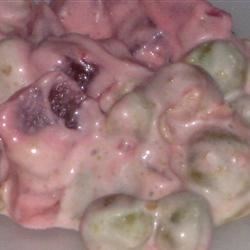
And here's a photograph of something called "Mom Dill's Harlequin Salad":


But we're looking for salads of harlequin designs, and I'm sorry, but there's just no design there. Mom and her ilk are simply using the word "harlequin" to mean multicolored. Harlequin design has got to refer to a much more distinctive diamond shape pattern typical of the Commedia dell'Arte character. Like this:


So I'm picturing some mound of edible material with criss-crossing strips of pimento. Ah! Here: "Fancy Salads of the Big Hotels." That book is from 1921, one year before the events in "The Great Gatsby" are supposed to take place. And here's Robert Salad:
Place two slices of tomato on half a heart of romaine, and on top place two rings of green pepper. Lay a slice of hard boiled eggs in each of the rings and decorate with diamond shaped dice of pimento.
I know. It's really no less disgusting than Mom's concoction. But were we supposed to be licking our chops over this? It's a sentence read in isolation, but I'm guessing we were supposed to think this spread was extravagant and yet... we're happy to stay home with Mom and her ilk after the 4 buckets of Miracle Whip with canned goods have disappeared, down the various household gullets.

Bewitching!
Read more ►

Monday, 21 January 2013

"Her face, above a spotted dress of dark blue crêpe-de-chine, contained no facet or gleam of beauty..."

0 comments
"... but there was an immediately perceptible vitality about her as if the nerves of her body were continually smouldering."

"The Great Gatsby" is flowing with light and darkness, we've seen time and again in this Gatsby project (where we isolate our sentence of the day and have at it). We can almost always begin with the question: Where is the light? And if not where is the light then: Where is the energy that is like light? Some sentences are just light and darkness chasing each other around. Sometimes we get an overwhelming darkness, but there's a play of light.

Today we have a description of a woman, whose face and body each has its own separate claws clause. There's her face above a spotted dress of dark blue crêpe-de-chine. So the dress, the inanimate thing is the overwhelming darkness. The face, being "above," seems detached...


It's devoid of light — no gleam. None of the gleam that would be beauty. No facet...


So forget that face. How about the body under the dress — the dark, spotted dress?


Here, we find the energy, but it's not light. It's fire. Under the dark dress, there is vitality. It's perceptible, as if we're seeing through the spotted dress down into her nerves, her slowly burning — smouldering — nerves.
Read more ►

Saturday, 19 January 2013

"Sometimes a shadow moved against a dressing-room blind above, gave way to another shadow, an indefinite procession of shadows, that rouged and powdered in an invisible glass."

0 comments
Earlier today, I made a "café" post out of a photograph of a tablescape that included my small toy robot, and betamax3000 used it as an occasion — a "café" post is an open thread — to speak for the robot, saying Althouse-blog-related things like: "Robot has no need for F. Scott Fitzgerald. Robot has no need for extraneous data." And "Robot would eradicate Gatsby of unnecessary organic units. Story now smaller."

The Althouse blog has an ongoing Gatsby project consisting of quoting and talking about one sentence from "The Great Gatsby" every day. No one remembers why. It's simply a tradition on the Althouse blog. There's talk of switching to "Lady Chatterly's Lover" or "The Little Prince," but these are rumors, borne in on the breeze that sweeps through the windows and makes the curtains swirl upward into the ceiling that seems like a wedding cake.)

So I've chosen a sentence for Robot/betamax3000 with all the organic units pre-eradicated. A shadow moves. That's the action. It moves and gives way to... guess what?!... another shadow. And more and more shadows. A procession of shadows. A shadow parade. Another inanimate thing is the dressing-room blind. And since we've got a dressing room, we can imagine an organic unit putting on makeup — rouge and powder — but our organic units are eradicated, so it's nothing but a shadow, the absence of a living person, and lest you think you see a person in that mirror in the dressing room, F. Scott Fitzgerald will have you know that even the looking-glass is invisible.
Read more ►

Wednesday, 16 January 2013

"A breeze blew through the room, blew curtains in at one end and out the other like pale flags..."

0 comments
"... twisting them up toward the frosted wedding-cake of the ceiling, and then rippled over the wine-colored rug, making a shadow on it as wind does on the sea."

More wind, water, and light. We've gotten used to it here in this windy, watery, light-and-dark world of the Gatsby project. This sentence seems like a made up imitation of a sentence from "The Great Gatsby," but I assure you it's there.

All that's happening here is a breeze blowing through the room, but we have a traffic jam of metaphor: flags, wedding-cake, and wine. What are we supposed to see here? And good lord, it's a room. Must we really believe that something cataclysmic is going on when a breeze blows the curtains? Maybe we should. Maybe all sorts of crazy stuff happens in a room and it is like an epic storm at sea.

The wine-colored rug stands in for the sea, so I have to assume that we're supposed to think of the  "wine-dark sea" we hear about, repeatedly, in Homer's Iliad and Odyssey. It is an epic, contained in that room. The dark shadows ripple, turning the wine-rug into sea, so I guess the ceiling is the sky. I guess that's a fancy white ceiling with all sorts of fancy woodwork, resembling the ornamentation on a wedding cake. The curtains swirling around the wedding-cake textures are cloud-like, I suppose. So fabric and wood make the erstwhile cake-like ceiling into stormy sky and curtain-driven shadows make the otherwise wine-like carpet into roiling sea.

It's a tempestuous room, containing a marriage. Raise a toast and let's feed each other cake.
Read more ►

Tuesday, 15 January 2013

"He lit Daisy’s cigarette from a trembling match, and sat down with her on a couch far across the room..."

0 comments
"... where there was no light save what the gleaming floor bounced in from the hall."

Today's sentence, in the Gatsby project, where we read one sentence from "The Great Gatsby" each day.

What jumps out — bounces out — at me here is the dual light action: the lighting of the cigarette and the light bouncing in from the hall. The sources of light: 1. a trembling match, and 2. a gleaming floor. Both light sources go with -ing words. The light that has to do with a person doing something is trembling, and the light whose action has no human agent gleams and bounces. There's a big contrast between the emotional content of the 2 lights, the one — trembling — in the dark, in the intimate relationship between the man's hand and the woman's mouth, and the other — bouncing — off the floor from a shiny, bright place.

I've called attention to the light action that is human and that is not, but in this... light!, it's important to see what is not said. We don't get "trembling hand." We get "trembling match." The man is there in the "He" — "He lit" — but there's something cagey or removed about saying it's the match that's trembling. A trembling hand is only implied. That makes the lights more inanimate, but it also heightens the picture of light. We see the burning match, not the hand. And that puts the man-woman intimacy more deeply in the dark. They get as deep into the dark room and away from the light as they can. Good reason to tremble.
Read more ►

Monday, 7 January 2013

Rising before dawn...

0 comments
... to see this...

Untitled

... before this:

Untitled
Read more ►

Wednesday, 2 January 2013

"Through this twilight universe Daisy began to move again with the season..."

0 comments
"... suddenly she was again keeping half a dozen dates a day with half a dozen men, and drowsing asleep at dawn with the beads and chiffon of an evening dress tangled among dying orchids on the floor beside her bed."

We're sticking to sentences, here in our "Gatsby" project. I won't pretend not to know that Daisy is the main female character in the book, but for the purposes of this project, I'm disregarding what we know about her and where she might be in the plot line when this sentence appears. I'd like to follow a rule that excludes all extrinsic evidence, but the phrase "this twilight universe" shows why that rule may be too severe. Nevertheless, I'm going to stick with the no-extrinsic-evidence rule, and accept "this twilight universe" as a mystery. Daisy has been up to something in what is now being referred to as "this twilight universe," and there's something poignant about encountering someone — a flower-named woman — in a mysterious place where she has moved before and is beginning to move again.
That Daisy's renewed movement comes with the season makes us think of the plants that come and go seasonally. One third of the way through the sentence, we are thinking about the annual cycle of the seasons as well as the daily cycle of light and dark that contains twilight. A flower that is a woman moves within the inexorable movements of the universe.

This lone female is suddenly joined by numerous men. Though the unnamed men never get definition as individuals, they presumably get one-on-one dates with her, since the numbers match up: half a dozen dates a day with half a dozen men. This is the kind of "dating" one associates with a prostitute. The "twilight universe" feels more sinister, and the next thing we see is Daisy in bed: drowsing asleep at dawn. The daily sun cycle has turned from twilight to dawn, the 6 dates have somehow been cranked through and (suddenly) there is our wilted flower on her bed, but there is a string of words — like a string of men — that we must experience before we get to to "bed" (the last word of the sentence (she and we must get to bed)).

The words are the things on the floor beside her bed: "the beads and chiffon of an evening dress tangled among dying orchids." Orchids! There is Daisy — the flower we associate with freshness and simplicity — and there, next to her, on the way to the bed, are the complicated flowers whose name, literally, means testicles. So the 6 men were unnamed, but there is a name that bespeaks male sexuality. And there are those testicles, dying (as Daisy is drowsing), dying and all tangled up the pretty tatters — beads and chiffon — of what once was a dress.

Note carefully that it is not a dress that is tangled up with the orchids, it is the beads and chiffon, suggesting that the delicate dress has lost all integrity. And yet our Daisy has disentangled herself from the spewings of sex that lie on the floor. And she's not passed out, dead drunk. She's drowsing, in her presumably pretty nakedness.

It's dawn, and she will emerge again, with the cycle of the new day, fresh and daisy-like again. Remember, she was only beginning to move through this twilight universe, and with the new day, the movement will continue, with 6 more men and another dress to move through. She's not caught in this twilight universe. She moves through it. She gets through the men and through the dresses, and sleeps lightly as the detritus dies on the floor.
Read more ►
 

Copyright © Diet Althouse Design by O Pregador | Blogger Theme by Blogger Template de luxo | Powered by Blogger