Tuesday, 29 January 2013
Thursday, 17 January 2013
"Americans, while occasionally willing to be serfs, have always been obstinate about being peasantry."
Think hard. It doesn't really matter — does it? — that this is today's sentence from "The Great Gatsby," another dutiful posting in our Gatsby project, wherein we look at one sentence, out of context, each day. I know the context of that sentence. I know what happened in the story. You can look it up.
It's so tempting to break out of the form of the project and tell you, to go back into the paragraph, even as I want to tempt you out of the book altogether to look at this proposition that Americans are willing — occasionally! — to be serfs but won't accept the notion that they are peasants. What's the difference?!
But I've got to tell you. There was a rich man — not Gatsby — who tried to get the people in the houses around his house to accept having their roofs thatched with straw. He offered to pay their taxes for 5 years if they'd accept this imposition which would have allowed him to have a nice view of a faux-peasant village. They refused, and the rich man, we're told, "went into an immediate decline." And "His children sold his house with the black wreath still on the door." That's how Gatsby got his house. So that's the peasant idea that offends Americans.
But serfs. We are willing to be serfs.
Read more ►
It's so tempting to break out of the form of the project and tell you, to go back into the paragraph, even as I want to tempt you out of the book altogether to look at this proposition that Americans are willing — occasionally! — to be serfs but won't accept the notion that they are peasants. What's the difference?!
But I've got to tell you. There was a rich man — not Gatsby — who tried to get the people in the houses around his house to accept having their roofs thatched with straw. He offered to pay their taxes for 5 years if they'd accept this imposition which would have allowed him to have a nice view of a faux-peasant village. They refused, and the rich man, we're told, "went into an immediate decline." And "His children sold his house with the black wreath still on the door." That's how Gatsby got his house. So that's the peasant idea that offends Americans.
But serfs. We are willing to be serfs.

Wednesday, 16 January 2013
"15 Frugal Billionaires Who Live Like Regular People."
Fascinating and really cool. Got us going talking about why someone would do this (other than being nutty). Highlights:
1. Warren Buffet, worth $46 billion, "still lives in the Omaha, Nebraska, home he bought for $31,500 more than 50 years ago." And Carlos Slim Helú, chairman and CEO of Telmex, worth $69 billion, has lived in the same modest house he's had for the last 30 years. Christy Walton, worth $27.9 billion raised her son in an 1896 Victorian house so he could have a normal life and, after her husband died in a plane crash, donated the house to charity.
2. Chuck Feeney, co-founder of Duty Free Shoppers Group, gave away $4 billion, leaving himself with (currently) $2 million, and he orders the second-cheapest wine on the menu. David Cheriton, worth $1.3 billion says he's "quite offended" by people who build big mansions, thinks "there's something wrong" with those people, and recently bought a Honda Odyssey.
3. Ingvar Kamprad, the founder of IKEA, worth $3 billion, claims to drive a 15-year-old Volvo and alway fly economy. He eats in cheap restaurants and has his house furnished with IKEA stuff. More on him here, including a picture of his unassuming ranch-style house.
Read more ►
1. Warren Buffet, worth $46 billion, "still lives in the Omaha, Nebraska, home he bought for $31,500 more than 50 years ago." And Carlos Slim Helú, chairman and CEO of Telmex, worth $69 billion, has lived in the same modest house he's had for the last 30 years. Christy Walton, worth $27.9 billion raised her son in an 1896 Victorian house so he could have a normal life and, after her husband died in a plane crash, donated the house to charity.
2. Chuck Feeney, co-founder of Duty Free Shoppers Group, gave away $4 billion, leaving himself with (currently) $2 million, and he orders the second-cheapest wine on the menu. David Cheriton, worth $1.3 billion says he's "quite offended" by people who build big mansions, thinks "there's something wrong" with those people, and recently bought a Honda Odyssey.
3. Ingvar Kamprad, the founder of IKEA, worth $3 billion, claims to drive a 15-year-old Volvo and alway fly economy. He eats in cheap restaurants and has his house furnished with IKEA stuff. More on him here, including a picture of his unassuming ranch-style house.
He always does his food shopping in the afternoon, when the prices in his local market start to fall....But Kamprad's image may be a big fake, and who knows about those other characters? The modest image helps the company's reputation, and they don't want to attract the attention of tax collectors, government regulators, and criminals (e.g., kidnappers).
Explaining his frugal nature, he said: "I am a bit tight with money, a sort of Swedish Scotsman. But so what?
"If I start to acquire luxurious things then this will only incite others to follow suit. It's important that leaders set an example. I look at the money I'm about to spend on myself and ask if Ikea's customers could afford it."
Thursday, 3 January 2013
And our "History of" country today is...
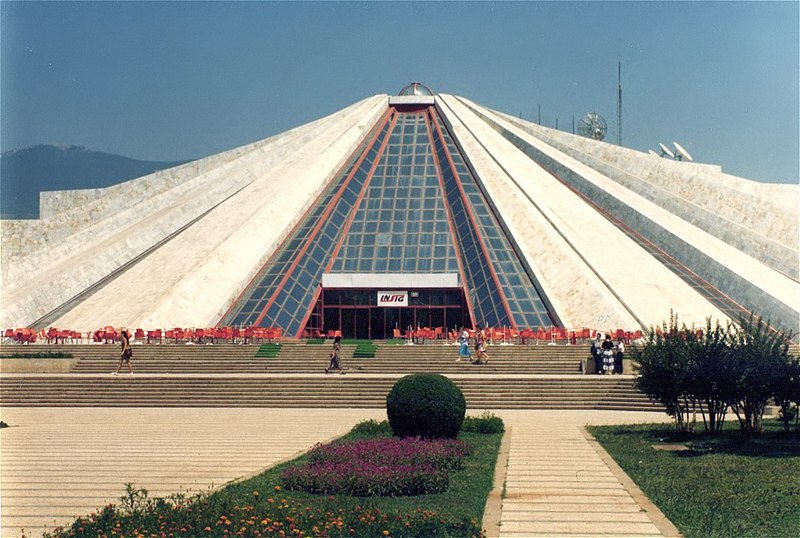
Do you recognize where this is? A clue: That's a photo of what used to be called the Enver Hoxha Mausoleum. If I told you it's in the capital city of Tirana, would you know the country, or is it easy because we are proceeding through the Wikipedia "History of" pages for the 206 countries in the world in alphabetical order?
This is Albania, a region where, in antiquity, the Illyrians lived. There was Roman rule, Byzantine rule, invasions by Visigoths, Huns, and Ostrogoths, the Bulgarian Empire, and the Ottoman Empire:
Part of the Albanian population gradually converted to Islam, with many joining the Sufi Order of the Bektashi. Converting from Christianity to Islam brought considerable advantages, including access to Ottoman trade networks, bureaucratic positions and the army.... The Albanians proved generally faithful to Ottoman rule following the end of the resistance led by [feudal heir] Skanderbeg, and accepted Islam more easily than their neighbors. No fewer than 42 Grand Viziers of the Empire were of Albanian descent....There was WWI, then the rule of King Zog, who initiated reforms (such as ending the custom of making one's region part of one's name) and who was overthrown by the Italians under Mussolini in 1939. Mussolini "saw Albania as a historical part of the Roman Empire" and imposed "a policy of forced Italianization." After the Italian surrender in 1943, Germany occupied Albania. Germany "sought to gain popular support by backing causes popular with Albanians, especially the annexation of Kosovo.... Albanian collaborators... expelled and killed Serbs living in Kosovo."
[I]n the 19th century... an Albanian National Awakening took place and many revolts against the Ottoman Empire were organized...
The Principality [of Albania] was established on 21 February 1914. The Great Powers selected Prince William of Wied, a nephew of Queen Elisabeth of Romania to become the sovereign of the newly independent Albania....
After the Soviets liberated Albania in 1944, Enver Hoxha, the secretary general of the Albanian Communist Party, became the leader of the Socialist People's Republic of Albania, and he continued on in that role for 41 years, until he died in 1985.
In 1967, the authorities conducted a violent campaign to extinguish religious practice in Albania, claiming that religion had divided the Albanian nation and kept it mired in backwardness. Student agitators combed the countryside, forcing Albanians to quit practicing their faith. Despite complaints, even by APL members, all churches, mosques, monasteries, and other religious institutions had been closed or converted into warehouses, gymnasiums, and workshops by year's end.The Communists were defeated by the Democratic Party in 1992. Efforts to introduce capitalism — Wikipedia says — "led to the proliferation of pyramid schemes" and "anarchy," which was stabilized by "an EU military mission led by Italy." In 2009, Albania joined NATO.
That's enough from Wikipedia for now. I can't vouch for the accuracy of any of that, but it's a jumping off place that is far beyond anything I'd had in my head before reading it. Enver Hoxha? Previously unfamiliar to me. And his erstwhile mausoleum? Horrific. Looking for better images, I found this nice Flickr stream, and I'll send you to this image first, because I love it. Then you you can click the "newer"/"older" buttons to see what else is there.
Tuesday, 1 January 2013
"Every Friday five crates of oranges and lemons arrived from a fruiterer in New York..."
"... every Monday these same oranges and lemons left his back door in a pyramid of pulpless halves."
I warned you I was going to do this. Come on. Play along. (And, no, I wasn't thinking about Andy Kaufman when I dreamed this up. It was all a riff on that Baz Luhrmann trailer for the new "Great Gatsby" movie.)
So, now, let's talk about oranges and lemons. The phrase "oranges and lemons" appears twice in the sentence, unchanged, even as the oranges and lemons themselves are changed. That's the whole action of the sentence, the transformation of oranges and lemons in one form into oranges and lemons in another form. Here they are on Friday, in crates, and here they are on Monday in "a pyramid." That is, they have become, in that alluded-to time period — the weekend — a pile of garbage. But the pile is called "a pyramid," A pyramid! We're called upon to think of the grand erections of pharaohs, in comparison to crates from the lowly little character with the silly-sounding occupation "fruiterer."
Are the crates even stacked up? There's the absurd and obviously false notion that the fruit has been improved by whatever it was that went on in that house over the weekend. That absurdity calls upon us to think about the people who arrived and left, the people who ate all that fruit. But of course, they didn't eat it. They drank it. The pulp was extracted for use in alcoholic mixtures, and if the fruit emerged from the weekend as "pulpless halves," then, we may infer, so did the people. We don't hesitate to keep calling them human, yet we see the inaptness of calling the mere rinds "lemons and oranges." Even if you could conceptualize the big pile of rinds as a pyramid, you'd easily perceive it as garbage. Since that perception is easy, we have energy left to think about what is more difficult. Who are these people?
Read more ►
I warned you I was going to do this. Come on. Play along. (And, no, I wasn't thinking about Andy Kaufman when I dreamed this up. It was all a riff on that Baz Luhrmann trailer for the new "Great Gatsby" movie.)
So, now, let's talk about oranges and lemons. The phrase "oranges and lemons" appears twice in the sentence, unchanged, even as the oranges and lemons themselves are changed. That's the whole action of the sentence, the transformation of oranges and lemons in one form into oranges and lemons in another form. Here they are on Friday, in crates, and here they are on Monday in "a pyramid." That is, they have become, in that alluded-to time period — the weekend — a pile of garbage. But the pile is called "a pyramid," A pyramid! We're called upon to think of the grand erections of pharaohs, in comparison to crates from the lowly little character with the silly-sounding occupation "fruiterer."
Are the crates even stacked up? There's the absurd and obviously false notion that the fruit has been improved by whatever it was that went on in that house over the weekend. That absurdity calls upon us to think about the people who arrived and left, the people who ate all that fruit. But of course, they didn't eat it. They drank it. The pulp was extracted for use in alcoholic mixtures, and if the fruit emerged from the weekend as "pulpless halves," then, we may infer, so did the people. We don't hesitate to keep calling them human, yet we see the inaptness of calling the mere rinds "lemons and oranges." Even if you could conceptualize the big pile of rinds as a pyramid, you'd easily perceive it as garbage. Since that perception is easy, we have energy left to think about what is more difficult. Who are these people?
Subscribe to:
Posts (Atom)

