Saturday, 26 January 2013

"Buy yourself a shotgun"... maybe not a real shotgun, maybe something metaphorical.

0 comments
So, yeah, there's Jimi Hendrix, on TV in 1965. Can you even hear him? I want to concentrate on Buddy & Stacy. I'm surprised they got away with dancing like that on television:


Those were different times.
Read more ►

Friday, 25 January 2013

I was so tired when I wrote last night's "Gatsby" post.

0 comments
It was a real struggle with that sentence:
There was dancing now on the canvas in the garden; old men pushing young girls backward in eternal graceless circles, superior couples holding each other tortuously, fashionably, and keeping in the corners — and a great number of single girls dancing individualistically or relieving the orchestra for a moment of the burden of the banjo or the traps.
You might say I wrestled with that sentence. The commenters — whom I read this morning, after I conked out and slept for 10 hours — helped me make the connection to wrestling. Terry said: "The key phrase, I think, is 'on the canvas.'" That affects how you think of the men pushing the young girls, the gracelessness, and the tortuously. Dancing is like wrestling here. In the "Gatsby" project, we look into one sentence, in isolation, but I just looked back into the text to get a better picture of that canvas, which I took to be a way to transform lawn into dance floor. I get to this sentence:
At least once a fortnight a corps of caterers came down with several hundred feet of canvas and enough colored lights to make a Christmas tree of Gatsby’s enormous garden.
So let that be today's sentence. Lots of Cs: corps, caterers came, canvas, colored, Christmas. Christmas replacing the garden evokes the New Testament supplanting the Old. From the Garden of Eden to the salvation of Christ. By the way, that is the sentence just before the "crowded hams" sentence that made me angry 3 days ago.

I'll leave you to untangle the strands of colored lights that festoon the Christmas tree sentence, because I need to get back to what people said about yesterday's sentence. I must say I laughed out loud when McTriumph said:
Professor Ann, your first thought was musicians using the girls as instruments? You should write a novel, "Fifty Shades of Banjo."
And then betamax3000 introduced Naked Andy Kaufman Robot. Betamax has done this "naked robot" routine before, but the Andy Kaufman iteration blew my mind, because I was still admiring Terry's wrestling insight, with men wrestling/dancing with woman, and then to bring up Andy Kaufman — when Kaufman not only had a comic act that was about wrestling with women, but he had a routine that consisted of taking the stage and reading, in its entirety, "The Great Gatsby." But it's not as if betamax3000 just said, "Hey, this is so Andy Kaufman — the wrestling and 'The Great Gatsby.'" No, betamax did a series of comments that twisted the "Gatsby" text into things that would be said by the Naked Andy Kaufman Robot:
I have pushed many women gracelessly backwards on canvas. It has been both tortuous and fashionable, leaping high from the corners of the ring onto the contestant below: in that moment there is Truth, Sweat and Cheers. Many people assume the urge to wrestle women is sexual. As a wrestler of women I can definitively say that this is untrue. Mostly. In the main it is about the defining moment of being Superior, of recognition of the Pinner and the Pinnee.
A few moments on Etiquette.

A sportsman never uses the Banjo or the Traps on a female wrestler. While he is allowed to use the Piledriver it is not to be done from a height greater than a women's modest skirt: below the knees only, gentlemen.

Danny DeVito did not understand. He would ask "Andy, why don't you stop wrestling women?" and I would reply "Danny, why don't you stop being so short and disheveled?"

Shirt tucked or not, in the ring Danny would've been able to stand as tall as his Courage would allow him to be, but -- sadly --he did not understand.

Tony Danza would argue "I'm a boxer. What would be so different if I boxed women?"

I could only shake my head. He did not comprehend the difference between wrestling and fighting. A punch is anger, but only through grappling do we experience the common ground between the sexes: the canvas ring is where the true colors are painted, like a woman's red nails or a man's 1969 orange Camaro.

I once wrestled a woman who smelled of avocado. In the midst of our grappling a moment was frozen as that scent overpowered my senses, psychically and spiritually. Was the avocado Fear or Power? How could I pin this woman down, this woman who smelled of avocado? How could I keep her soul and buttocks confined beneath me when the Avocado was everywhere? In the end I won the match, but the avocado defeated me on a far grander level.

Every woman has the Avocado inside her -- this, a true wrestler knows -- knows and respects...
And:
The first time I wrestled a woman was practically a religious experience. At the end I laid on the canvas pinned, defeated and euphoric: through my bell-rung eyes I saw God through the rafters wink at me. I do not remember her name but I remember the look of Victory in her eyes and how I peed a little.
And:
Women have soft elbows. When you are elbowed in the solar plexus by a woman it is different than a man's elbow: there is Understanding. There is Forgiveness.
And:
When pinned between a woman's headstrong knees a man has no choice but to understand: it is the Silent Conversation, and the chafing will heal.
And:
To repeat: wrestling a woman is not sexual. Excitement is for the Soul and the Arms and the Thighs, not the Loins. To have an erection in the ring is to give the Devil a Handle.
There's more, but enough of the quoting of the Naked Andy Kaufman Robot. Let's turn to the wonderful commenter Chip Ahoy, crisply quipping:
Later, following the death of Gatz, the same canvas was turned over to modern dance.


But that didn't last. The dancers, bored of dancing set off in pairs to the beach, to break up and pair off again and break up and pair off.

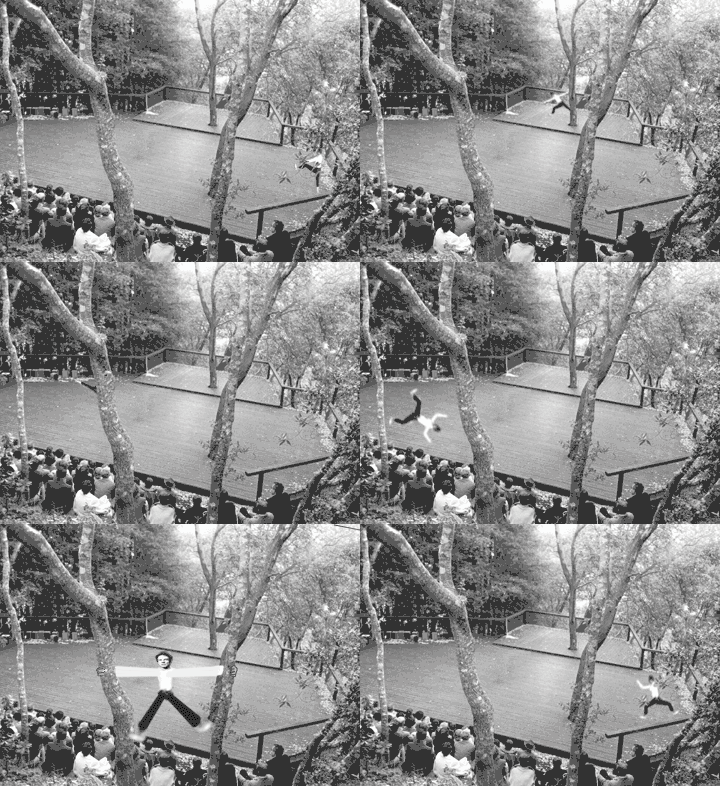
I remember that modern dance GIF. It was back in 2009, when I wrote about "Lawrence Halprin... 'the tribal elder of American landscape architecture'" whose wife was a dancer who, he said, "could not be contained by a rectangle," so he built her a dance deck that was the "odd, improvised shape" you see in the photo. Back then Chip Ahoy said:
I too knew that my wife could not be contained on a rectangular deck for she is uncontainable, so I improvised with an deck area that could be danced on several levels. The outer levels tilt so that anything placed on them slide off toward the center, and built with portals that promise escape but all lead circuitously back to the main dance area, rather like a hamster habitat. I rounded the edges and varied the angles for nature has few straight lines and fewer right angles and my wife is nature personified, and that made the whole deck railing more difficult, you see, which I then electrified because I knew she would make several attempts at an over-the-rail vault. The deck areas are also surrounded by a moat that I populated with piranhas that I feed regularly by dropping in a steak so they're veritably trained to converge en mass, along with back up electric eels and those really gross blood-sucking slugs, all to discourage wandering beyond the safety of boundaries I set forth with my architecture. The deck itself is fitted with sprinklers at its farthermost points that spray a mist with power hose force to warn the little sylph-like dancing scamp whenever her dance gives the appearance of breaking loose or she nears the end of her retractible chain.
And then Chip proceeded to animate a dancer for the odd, improvised dance deck.

And now, it's your turn to dance. Dance all night in the comments, backward in eternal graceless circles, tortuously, fashionably, individualistically.
Read more ►

Monday, 21 January 2013

Michelle and Barack Obama look great in the Inauguration morning outfits.

0 comments
Very nice. Love the blue. Love the matching clasped hands as — we're told — they approach the Episcopal Church. Michelle's checker-patterned coat is made of "silk jacquard based on a necktie fabric." Beautiful!

In church:
... Pastor Andy Stanley from North Point Community Church in Alpharetta, Ga., delivered the sermon. He spoke of Jesus washing his disciples' feet and saying "now that I, your Lord and teacher, have washed your feet, you should also watch each other's feet." The president, Pastor Stanley said, should follow that example and "leverage" his power for the benefit of others.
IN THE COMMENTS: Erika notes the typo in the blocked quote, which is from NPR.org:  You should also watch each other's feet. Maybe NPR misheard and didn't get what Jesus was supposedly doing. Some commenters thought Pastor Stanley didn't get what Jesus meant.

Palladian: "The washing of the feet was about humility and service, not about 'leveraging power.'"

Cheryl: "I'm pretty sure Jesus didn't need to leverage his power. Biblical teaching like this is why we don't attend Pastor Stanley's church, which is right down the road from us."

Bago20 reacted: "Nooooooooooooooooooooo! Please don't help anymore."

Maguro had a different problem: "I find it disturbing that even southern preachers are using 'leverage' as a verb these days."

MORE IN THE COMMENTS: I said: "The humble servant image is a little edgy when the President is black." And Palladian said: "The humble servant image is a little edgy when the President is a profligate, arrogant, narcissistic asshole."
Read more ►

Wednesday, 16 January 2013

"A breeze blew through the room, blew curtains in at one end and out the other like pale flags..."

0 comments
"... twisting them up toward the frosted wedding-cake of the ceiling, and then rippled over the wine-colored rug, making a shadow on it as wind does on the sea."

More wind, water, and light. We've gotten used to it here in this windy, watery, light-and-dark world of the Gatsby project. This sentence seems like a made up imitation of a sentence from "The Great Gatsby," but I assure you it's there.

All that's happening here is a breeze blowing through the room, but we have a traffic jam of metaphor: flags, wedding-cake, and wine. What are we supposed to see here? And good lord, it's a room. Must we really believe that something cataclysmic is going on when a breeze blows the curtains? Maybe we should. Maybe all sorts of crazy stuff happens in a room and it is like an epic storm at sea.

The wine-colored rug stands in for the sea, so I have to assume that we're supposed to think of the  "wine-dark sea" we hear about, repeatedly, in Homer's Iliad and Odyssey. It is an epic, contained in that room. The dark shadows ripple, turning the wine-rug into sea, so I guess the ceiling is the sky. I guess that's a fancy white ceiling with all sorts of fancy woodwork, resembling the ornamentation on a wedding cake. The curtains swirling around the wedding-cake textures are cloud-like, I suppose. So fabric and wood make the erstwhile cake-like ceiling into stormy sky and curtain-driven shadows make the otherwise wine-like carpet into roiling sea.

It's a tempestuous room, containing a marriage. Raise a toast and let's feed each other cake.
Read more ►

"Oxygen Media has pulled the plug on 'All My Babies' Mamas,' a reality special... about a musician who has fathered 11 children with 10 different mothers."

0 comments
The conceived the show. They gave it life. Then they walked away.

ADDED: Rush Limbaugh riffs on the O Media decision:
It's not gonna air now because a bunch of stuffed shirts, a bunch of prisses, a bunch of morality police... objected.... So we were going to expand the definition of a family to include whatever people wanted it to be.... It was a show of love and devotion, how Shawty provides for all, and it's being ripped right out from under him. I mean, who says that this is a marginalized existence?
Read more ►

Sunday, 13 January 2013

"I knew the other clerks and young bond-salesmen by their first names, and lunched with them in dark, crowded restaurants on little pig sausages and mashed potatoes and coffee."

0 comments
It means something that F. Scott Fitzgerald wrote "pig" instead of "pork." I think about how George Harrison sang about piggies, the bigger piggies, "in their starched white shirts... stirring up the dirt" as well as "the little piggies... crawling in the dirt." (He stirred up Charles Manson to deliver "a damned good whacking.")

Life was "getting worse" for the little piggies, while, by contrast, the bigger piggies "always had clean shirts." Now, I'm not going to veer off into the topic of The Great — big pig — Gatsby's shirts. You know if you've read "The Great Gatsby" or seen the movie that a huge to-do is made at one point about how many beautiful shirts Gatsby had.

But here in this Gatsby project, we look at one sentence in isolation. That way, everyone's on the same footing. You don't have the little readers and the bigger readers. Life isn't getting worse for some of us and just fine for others. We gather here, in the daily post, to consume one sentence, so let's lunch.

Let's know each other by first names. Here we are equals. We have all read the sentence, and we can all very well speak out about it. Here, we actively exclude extrinsic evidence. About the book, I mean. We're free to drag in anything else, such as The Beatles, as betamax3000 did so well in yesterday's Gatsby thread, the one about warm human magic.

So pig, then. Pig, not pork. Which makes us think that the clerks and bond-salesmen are little piggies. The men eating humble food — all the humbler for saying pig, not pork — in a dark, crowded place. A pigsty? Our narrator is crammed in close quarters with them as he chows down. He's on familiar terms with them: He calls them by their first names. He's a member of the herd of little piggies.

Did you notice the words are right there one after the other: little pig? As a competent and tolerant reader, you can tell it's the sausages and not the pigs that are supposed to be little, and as a picky reader, you might say it's bad writing to permit that ambiguity to survive the final draft. But maybe the writer wanted you to see little pig. And the bigger question is why insert the pig at all? We'd presume that sausages were pork. Obviously, Fitzgerald wants us to think about pigs and think about the men as pigs. He wasn't as blunt as Mr. Harrison, but he was calling these guys pigs.

Another reason to throw pig in there, permitting the ambiguity, is to call the sausages little without being too aggressively Freudian about saying little sausages and making us think too quickly — before we'd noticed all these other things — of pricks.

ADDED: Meade, helping me proofread, questioned "herd" as the proper collective term for pigs. I know there are some other options, but I like it because it evokes Jesus:
Some distance from them a large herd of pigs was feeding. The demons begged Jesus, “If you drive us out, send us into the herd of pigs.” He said to them, “Go!” So they came out and went into the pigs, and the whole herd rushed down the steep bank into the lake and died in the water. Those tending the pigs ran off, went into the town and reported all this, including what had happened to the demon-possessed men. Then the whole town went out to meet Jesus. And when they saw him, they pleaded with him to leave their region.
Read more ►

"Rehearsals sap my pep... tell me what I have to do and I'll do it."

0 comments
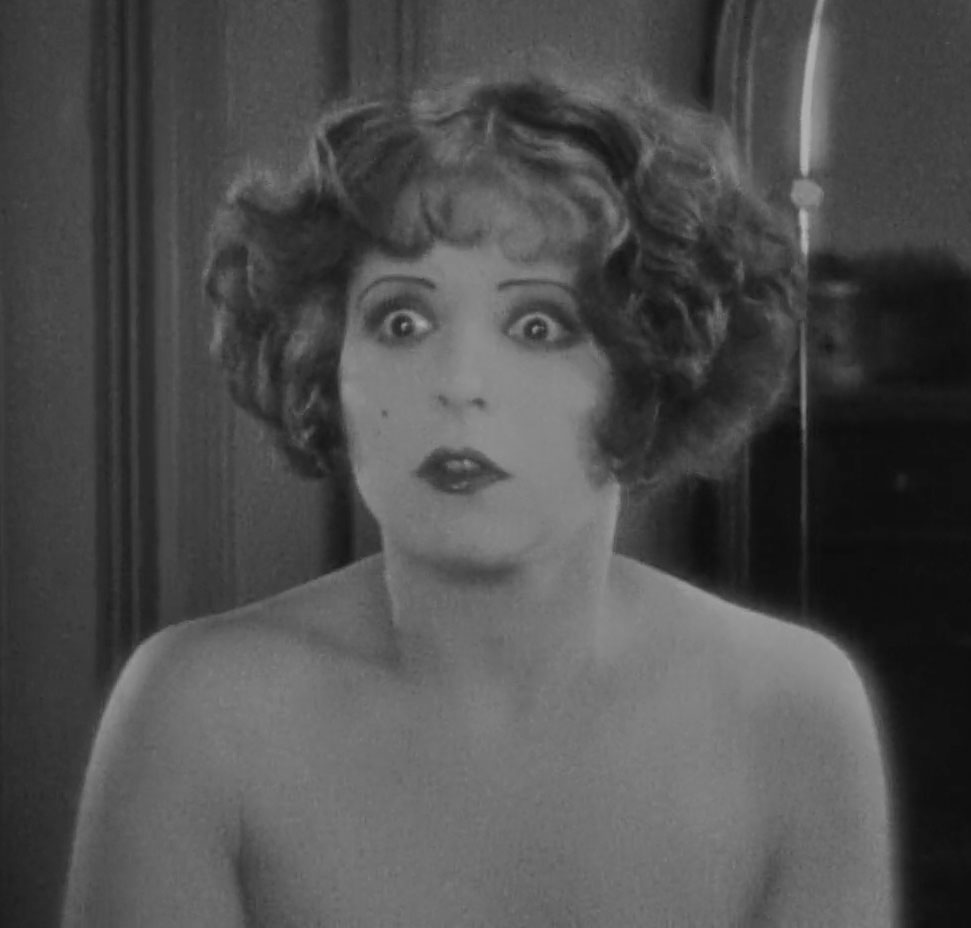
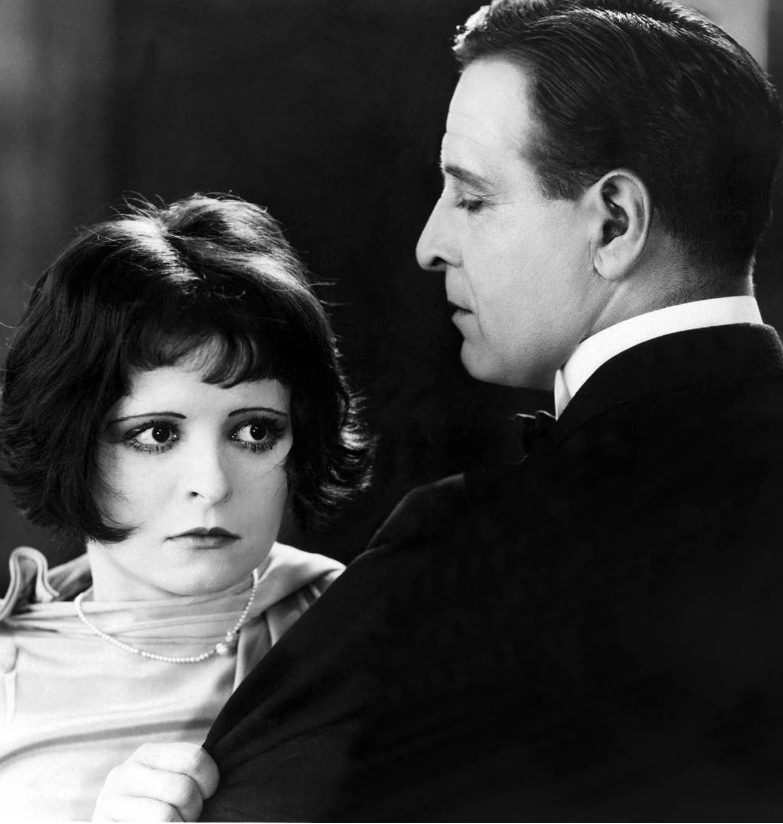
Said the actress Clara Bow (in 1929), who did it like this:


... in "Kittens" (1926). And this:


... in "Wings" (1927), which was the first movie to win the "Best Picture" Oscar. Bow said it was "a man's picture and I'm just the whipped cream on top of the pie." When Bow was criticized for her bohemian ways and "dreadful" manners, she said :
"They yell at me to be dignified. But what are the dignified people like? The people who are held up as examples of me? They are snobs. Frightful snobs... I'm a curiosity in Hollywood. I'm a big freak, because I'm myself!"
In 1931, when she was 26, she got married and retired from acting. She moved to a ranch in Nevada, and lived until 1965.

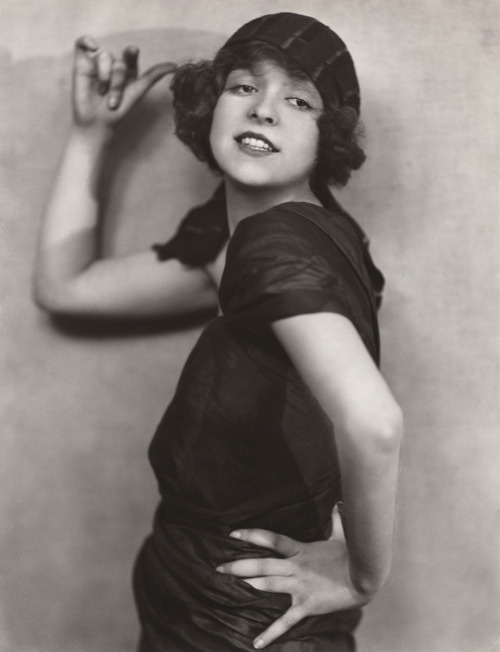
I'm reading about her this morning, after clicking to her Wikipedia page from the Wikipedia page "Pin-up girl," which has a list of "Notable pin-up girls" sorted by decades, beginning with the 1920s. I was researching the topic of pin-up girls after Meade called attention to this current ad:


We had a conversation about the nature of 1950s pin-up style, and it got me looking for the classic Betty Grable pin-up, which I think it emulates — peeking back over a raising shoulder and smiling as if to say Go ahead and look at my ass. Grable's pic is the one pic that appears on the Wikipidea "Pin-up girl" page, but I was interested in seeing the first pin-up, and the first couple names on the 1920s list didn't click through to a pin-up style picture. Clara Bow's did. If you count this:


Tell me what I have to do and I'll do it. She's only 15 there. Can you just hear the photographer directing her how to arrange her fingers and where to move her shoulder and even her eyeballs?
Read more ►

"That's how you laughed in the middle of the night."

0 comments
Said Meade, and I said: "Then Chip Ahoy must have been in my dream."

Because I was just reading his comment: "Melody and Rose broke up the Sweedish contractors and threw change in the tip jar and put on her warm magic apron."

And I laughed not because that is nonsense, but because it's a quite brilliant contribution to a conversation that was pretty far along at that point, including betamax3000's extended interpretation of "The White Album." Beta had said:
Like the White Album perhaps Althouse is telling us there are secret messages to be found, backwards.

"Sweetly up broke voice, her rose melody."

"Upon magic human warm her of little."

"Out tipped change."
It all began with a sentence from "The Great Gatsby," which was about — not a woman laughing — a woman singing. But women laugh all the time in "The Great Gatsby." For example: "She looked at me and laughed pointlessly."

"These 'Gatsby' posts are becoming the new café around here" — "café" posts are open threads  — I say as I drink my coffee and contemplate today's Gatsby sentence, which I'd said will be "I knew the other clerks and young bond-salesmen by their first names, and lunched with them in dark, crowded restaurants on little pig sausages and mashed potatoes and coffee."

I picked that sentence after searching my Kindle copy of "Gatsby" for "potato" after betamax3000 said:
Yesterday was "gulp down the incomparable milk of wonder," today is "tipped out a little of her warm human magic." Is it getting hot in here or is it just me?
And that was funny, because — before getting out of bed this morning — I'd been toying with the idea of saying: In that "Melody rose" sentence, Fitzgerald intended us to think of semen when we read about "warm human magic" that tipped out of the vessel that is the woman.
 

And betamax added:
My God: if we get to the sentence involving Daisy, the potato and the gardener I just don't know what is going to happen.
Which is what had me looking for "potato" in "Gatsby," not finding it, and suspecting that betamax was making a canny reference to "Lady Chatterly's Lover." I buy "Lady Chatterly's Lover" in Kindle just so I can search for "potato"! My literary pursuits are a tad — a tot — bizarre. I find:
"No; my heart's as numb as a potato, my penis droops and never lifts its head up, I dare rather cut him clean off than say 'shit!' in front of my mother or my aunt... they are real ladies, mind you; and I'm not really intelligent, I'm only a 'mental-lifer.'"
And:
"I don't want to fuck you at all. My heart's as cold as cold potatoes just now."
Read more ►

Wednesday, 9 January 2013

Obama's inauguration poet "tackles 'the intersection of his cultural identities as a Cuban-American gay man.'"

0 comments
The poet is Richard Blanco, the verb "tackles" comes from Politico, and the quote within the quote is in the Presidential Inauguration Committee press release.

I'm not a poet, but I pay attention to images, and I find the picture of tackling an intersection absurd in a particularly amusing way. Intersection of his cultural identities is also absurd but only in that dry, dreary academic way that makes you want to say to all your children and grandchildren: Do not major in the humanities!

What amuses me about tackling an intersection is that it seems to reveal the author's anxiety about the masculinity of the gay poet. Why make us picture a football move? Admittedly, the verb tackle originally meant to equip (a ship) with the necessary furnishing and then to harness (a horse), and only later "To grip, lay hold of, take in hand, deal with; to fasten upon, attack, encounter (a person or animal) physically." So says the OED. But it's all pretty damned macho.

There's no Blanco poetry at the link, but there is a description of an essay "Afternoons as Endora" from a collection "My Diva: 65 Gay Men on the Women Who Inspire Them."
“According to [my grandmother], I was a no-good sissy — un mariconcito — the queer shame of the family,” Blanco wrote. “And she let me know it all the time: Why don’t we just sign you up for ballet lessons? Everyone thinks you’re a girl on the phone — can’t you talk like a man? I’d rather have a granddaughter who’s a whore than a grandson who is a faggot like you.”
Go here for a little more of the writing, including Blanco's description of dressing up like Endora and watching "Bewitched" on TV:
Together we'd turn Mrs. Kravitz into a chihuahua, Derwood into a donkey, or Uncle Arthur into a chair. We were unstoppable....
I was a helpless and scared child, powerless against my grandmother, while Endora was a mighty witch with limitless powers. Unlike Samantha, her foolish daughter, she was a witch who wasn't afraid of being a witch, and used her magic to get her way or enact revenge every time she had a chance.
A fantasy of power. Suitable for a presidential inauguration.

AND: More on Blanco:
"Since the beginning of the campaign, I totally related to [Obama's] life story and the way he speaks of his family, and of course his multicultural background,” Mr. Blanco said... “There has always been a spiritual connection in that sense. I feel in some ways that when I’m writing about my family, I’m writing about him."...

Cynics might say that in picking a Latino gay poet, Mr. Obama is covering his political bases....
Aw, come on. People observing the normal things that happen in politics don't deserve to be called "cynics." OED defines "cynic" as:
A person disposed to rail or find fault; now usually: One who shows a disposition to disbelieve in the sincerity or goodness of human motives and actions, and is wont to express this by sneers and sarcasms; a sneering fault-finder.
Oh, what the hell. I'll accept the label. With politicians, we should be cynics. By the way, "cynic" comes from the Greek for dog-like (which you can sort of see in the word currish, which echoes in churlish).
Read more ►

Hope and change... into a clown costume.

0 comments
Paul Krugman responds to the pushback he's received on "the trillion-dollar-coin thing":
There seem to be two kinds of objections. One is that it would be undignified. Here’s how to think about that....
The professor is about to teach us how to think. Get ready!
... we have a situation in which a terrorist may be about to walk into a crowded room and threaten to blow up a bomb he’s holding. 
Okay. A hypothetical. I'm up for hypotheticals. And it's an analogy, because the trillion-dollar-coin thing isn't promoted as a solution to terrorism. But terrorism is something that you can picture quite concretely and you understand it as very real and scary — unlike the debt ceiling problem which is awfully abstract. (Even to say "ceiling" is to resort to metaphor.)

So, anyway:
It turns out, however, that the Secret Service has figured out a way to disarm this maniac — a way that for some reason will require that the Secretary of the Treasury briefly wear a clown suit. (My fictional plotting skills have let me down, but there has to be some way to work this in). 
In this hypothetical, you have to accept that the Secret Service has found "a way." It will work. The professor is telling you how to think, so you're going off track if you want an explanation for why that would work or if you — much more likely — would be thinking what the hell is going on in this country when the people in charge are figuring out solutions involving clown suits and believing that clown-suit solutions work? Krugman reveals that he knows his hypothetical is horribly flawed, and he tries to paper it over by confessing to second-rate "plotting skills." There has to be some way to work this it. The professor is teaching us how to think — use this analogy — but he can't piece together the hypothetical. How's that supposed to help us think?

He continues:
And the response of the nervous Nellies is, “My god, we can’t dress the secretary up as a clown!” Even when it will make him a hero who saves the day?
Wait. The normal people who go with the working theory that the government has gone mad are "nervous Nellies"? Yes, because Krugman's hypothetical locks it in that the solution works. So the people aren't supposed to be thinking that sounds crazy. It's posited that they know it will work, so all they can realistically be concerned with is that the secretary will look undignified dressed like a clown.

Krugman turns to the second objection, as if it's unconnected to the first one:
The other objection is the apparently primordial fear that mocking the monetary gods will bring terrible retribution.
Why weren't the people who say it looks crazy credited with having some fear that it wouldn't work? Because in the clown-suit hypothetical it was posited that it would work? These "nervous Nellies" were mocked in Part I of Krugman's krushing of all adversaries. In Part II, we see troglodytes who imagine a "god" who will punish us for doing something wrong.
What the hysterics see is a terrible, outrageous attempt to pay the government’s bills out of thin air. This is utterly wrong, and in fact is wrong on two levels.

The first level is that in practice minting the coin would be nothing but an accounting fiction, enabling the government to continue doing exactly what it would have done if the debt limit were raised....
So it's a trick, but it's not that different from other tricks. It's just weirder looking. Like a clown suit. Which gets back to the point I made when I criticized Krugman a couple days ago:
It's strange that it's come to this, but I don't believe the President of the United States would choose to do something that will strike the people as so bizarre, even if he feels capable of articulating the legal theory with a straight face. The President must maintain the people's trust and confidence. He must be comprehensible as normal, sound, and sane to ordinary folks.
Krugman's response to these ordinary folks — the people upon whom the President's power depends — is: They're hysterical and ill-informed. Well, how did this President — how does any President — get elected in the first place? It was by generating confidence. He's a con man. Let's say the management of the national debt has been a lot of trickery for a long, long time. What then does it matter if we do something that is quite obviously a trick, that everyone will see as a trick?

Does the trick work if the magician points to the hand that's doing the sleight?
Read more ►

Tuesday, 8 January 2013

"Gatsby, pale as death, with his hands plunged like weights in his coat pockets, was standing in a puddle of water glaring tragically into my eyes."

0 comments
The most interesting thing about today's "Gatsby" sentence is the use of plunged for the action of the hands into the pockets, when the feet are in a puddle of water. A puddle isn't deep, and Gatsby is just standing in the puddle. He can't be plunged into a mere puddle, but then again, his pockets are not bodies of water, so the plunging into the pockets is metaphorical.

The puddle is shallow and the pockets are not deep water, and Gatsby's hands aren't really weights. They're just like weights. But if you were weighted and plunged into deep water, you'd be in great danger of dying, and, indeed, Gatsby is pale as death. Drowning could be called a tragedy, and Gatsby is glaring tragically into the narrator's eyes.

Maybe you think this sentence is overwritten. Pale as death is a cliché and it's sort of redundant with glaring tragically.  Adverb adversaries would say you don't need tragically when you've already got glaring. Verbosity prigs might say if the narrator is able to see that Gatsby is glaring, it's tedious to go to the trouble to tack on into my eyes. And into my eyes is kind of a slow way to coast to an ending when you're trying to be this dramatic, what with death and weights and tragically dragging us down.

But maybe if we could escape from this isolated sentence — which we can't, in the Gatsby project as arbitrarily defined by me — we would see reason behind the seemingly weak into my eyes. Gatsby is desperate for something that must come, very specifically, from the narrator. Save me!

AND: Did "a puddle of water glaring tragically into my eyes" bother you?
Read more ►

Thursday, 3 January 2013

"They were both in white, and their dresses were rippling and fluttering as if they had just been blown back in after a short flight around the house."

0 comments
I decided to pluck something from Chapter 1 for today's entry in the "Great Gatsby" project. I randomly selected the sentence that appears above. You must believe me that it is indeed random, and yet someone had just emailed me to say he liked the Gatsby project and:
When I was a Harvard Freshman in 58-59, I took the required freshman English class and the instructor was an expert on Gatsby....

At one point while we were reading Gatsby for the class, he remarked "Have you noticed that whenever you see Daisy in the novel, she is wearing white?"
Now, how can my correspondent believe that I randomly picked a sentence with 2 women in white? But, on my purest honor, I did. We're focusing on sentences, so I don't know or care whether Daisy was one of the 2 women. I won't presume, though I will presume that the 2 entities known as "They" are women, given that they are wearing dresses. We must bring our knowledge of what is possible and what is probable to the enterprise of reading, even as we bear down on an isolated sentence. One or both of "them" might be a transvestite male (or a nonhuman), but I'm going to presume 2 women (or girls).

The "they" is perplexing in another, more disturbing way, because it reappears halfway through in "as if they had just been blown back." We're given a simile that asks us to picture the women, in their white dresses, flying around the house at some earlier moment. They — the women — look like they just landed, as their dresses are "rippling and fluttering" from a recent "short flight." But to say "their dresses were rippling and fluttering as if they had just been blown back" is to create ambiguity, the possibility that the "they" was "their dresses," and we might feel called upon to picture the dresses, by themselves, flying around the house before getting blown back onto the 2 erstwhile naked women. The flying-around-the-house image is fantastical, so we can't tap our our knowledge of what is possible and what is probable, and yet, somehow we know it was the women in their dresses who seem as if they'd just flown around the house and gotten blown back in.

I think the problem of 2 possible antecedents for the second "they" is a writing error, and this Gatsby project is premised on the greatness of the sentences. I hate to be the one to have to say a good editing eye would have seen that ambiguity, but the greatness of the sentence-writing doesn't require a complete absence of error, and the logic of the sentence precludes the dresses flying around the house on their own because we can't picture the dresses getting back on the women without losing the "rippling and fluttering" action caused by the flight and landing. So enough of that. Stop picturing naked women waiting while their dresses fly around the house.

It was the women, so magical and light, like birds or butterflies, that flew around the house. They could fly, but they didn't fly far, only around the house which they got blown back into. These women don't have much ambition or power on their own. They are housebound, even though they can fly. They do an orbit of the house and then a breeze sweeps them back in. But here they are, so pretty in their fluttery white dresses. And of course, they only look as if they'd taken that charmingly domestic flight. The truth is they are sitting together in the house, and they haven't been going anywhere. But there is a breeze, a breeze that might blow a butterfly into the house, and it ripples their flimsy dresses.
Read more ►

Wednesday, 2 January 2013

Yes, yes, I know, fiscal cliff jumped back from.

0 comments
We'd gone off, we were told yesterday, but somehow, from mid-air, we scrambled back. We were Wile E. Coyote out off the cliff, suspended, despite gravity, but unlike Wile E. Coyote, we already knew it, we'd been obsessing and blabbing about it for weeks. Unlike Wile E. Coyote, we didn't stay up because of ignorance of where we were and realization of where we were didn't make us plummet. We were somehow able to get back on the cliff, and it was exactly as if we'd never gone off the cliff.

It's almost as if there was never a cliff!

Read more ►

"Through this twilight universe Daisy began to move again with the season..."

0 comments
"... suddenly she was again keeping half a dozen dates a day with half a dozen men, and drowsing asleep at dawn with the beads and chiffon of an evening dress tangled among dying orchids on the floor beside her bed."

We're sticking to sentences, here in our "Gatsby" project. I won't pretend not to know that Daisy is the main female character in the book, but for the purposes of this project, I'm disregarding what we know about her and where she might be in the plot line when this sentence appears. I'd like to follow a rule that excludes all extrinsic evidence, but the phrase "this twilight universe" shows why that rule may be too severe. Nevertheless, I'm going to stick with the no-extrinsic-evidence rule, and accept "this twilight universe" as a mystery. Daisy has been up to something in what is now being referred to as "this twilight universe," and there's something poignant about encountering someone — a flower-named woman — in a mysterious place where she has moved before and is beginning to move again.
That Daisy's renewed movement comes with the season makes us think of the plants that come and go seasonally. One third of the way through the sentence, we are thinking about the annual cycle of the seasons as well as the daily cycle of light and dark that contains twilight. A flower that is a woman moves within the inexorable movements of the universe.

This lone female is suddenly joined by numerous men. Though the unnamed men never get definition as individuals, they presumably get one-on-one dates with her, since the numbers match up: half a dozen dates a day with half a dozen men. This is the kind of "dating" one associates with a prostitute. The "twilight universe" feels more sinister, and the next thing we see is Daisy in bed: drowsing asleep at dawn. The daily sun cycle has turned from twilight to dawn, the 6 dates have somehow been cranked through and (suddenly) there is our wilted flower on her bed, but there is a string of words — like a string of men — that we must experience before we get to to "bed" (the last word of the sentence (she and we must get to bed)).

The words are the things on the floor beside her bed: "the beads and chiffon of an evening dress tangled among dying orchids." Orchids! There is Daisy — the flower we associate with freshness and simplicity — and there, next to her, on the way to the bed, are the complicated flowers whose name, literally, means testicles. So the 6 men were unnamed, but there is a name that bespeaks male sexuality. And there are those testicles, dying (as Daisy is drowsing), dying and all tangled up the pretty tatters — beads and chiffon — of what once was a dress.

Note carefully that it is not a dress that is tangled up with the orchids, it is the beads and chiffon, suggesting that the delicate dress has lost all integrity. And yet our Daisy has disentangled herself from the spewings of sex that lie on the floor. And she's not passed out, dead drunk. She's drowsing, in her presumably pretty nakedness.

It's dawn, and she will emerge again, with the cycle of the new day, fresh and daisy-like again. Remember, she was only beginning to move through this twilight universe, and with the new day, the movement will continue, with 6 more men and another dress to move through. She's not caught in this twilight universe. She moves through it. She gets through the men and through the dresses, and sleeps lightly as the detritus dies on the floor.
Read more ►

Tuesday, 1 January 2013

"Every Friday five crates of oranges and lemons arrived from a fruiterer in New York..."

0 comments
"... every Monday these same oranges and lemons left his back door in a pyramid of pulpless halves."

I warned you I was going to do this. Come on. Play along. (And, no, I wasn't thinking about Andy Kaufman when I dreamed this up. It was all a riff on that Baz Luhrmann trailer for the new "Great Gatsby" movie.)

So, now, let's talk about oranges and lemons. The phrase "oranges and lemons" appears twice in the sentence, unchanged, even as the oranges and lemons themselves are changed. That's the whole action of the sentence, the transformation of oranges and lemons in one form into oranges and lemons in another form. Here they are on Friday, in crates, and here they are on Monday in "a pyramid." That is, they have become, in that alluded-to time period  — the weekend — a pile of garbage. But the pile is called "a pyramid," A pyramid! We're called upon to think of the grand erections of pharaohs, in comparison to crates from the lowly little character with the silly-sounding occupation "fruiterer."

Are the crates even stacked up? There's the absurd and obviously false notion that the fruit has been improved by whatever it was that went on in that house over the weekend. That absurdity calls upon us to think about the people who arrived and left, the people who ate all that fruit. But of course, they didn't eat it. They drank it. The pulp was extracted for use in alcoholic mixtures, and if the fruit emerged from the weekend as "pulpless halves," then, we may infer, so did the people. We don't hesitate to keep calling them human, yet we see the inaptness of calling the mere rinds "lemons and oranges." Even if you could conceptualize the big pile of rinds as a pyramid, you'd easily perceive it as garbage. Since that perception is easy, we have energy left to think about what is more difficult. Who are these people?
Read more ►
 

Copyright © Diet Althouse Design by O Pregador | Blogger Theme by Blogger Template de luxo | Powered by Blogger