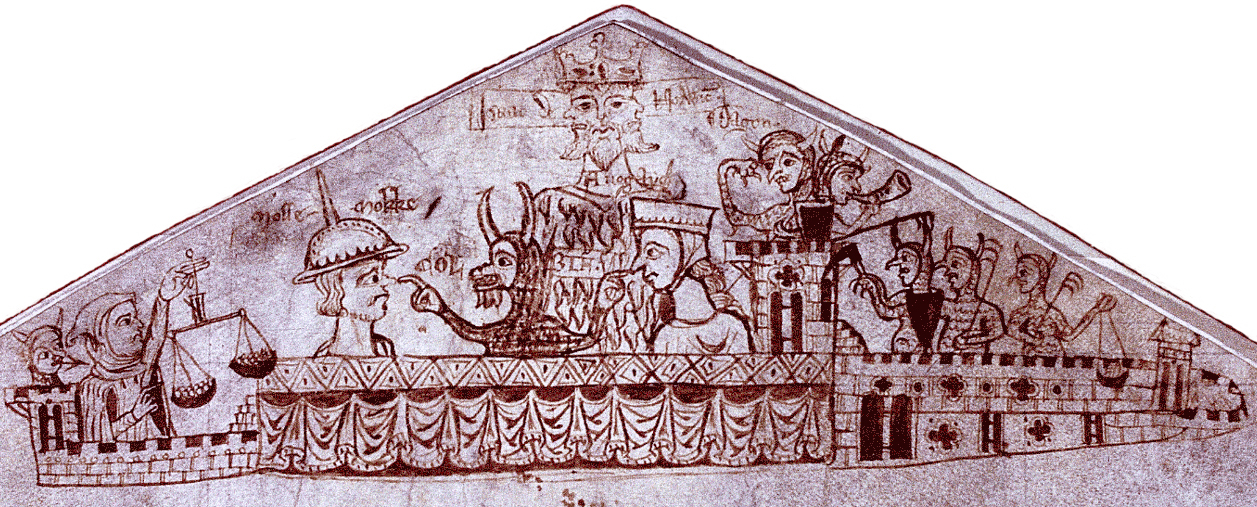
I'm fascinated by the school lesson material at the U.K. National Archive site. That cartoon is from one titled "A Medieval Mystery" that asks students to "decode the dark secrets of this cartoon" and offers tips on things to look for (e.g., devils) and prompts with questions like "How has the cartoonist shown that the man and the woman are Jewish?"
Browse » Home »
Posts filed under cartoons
Wednesday, 16 January 2013
A cartoon from 1233.
I'm fascinated by the school lesson material at the U.K. National Archive site. That cartoon is from one titled "A Medieval Mystery" that asks students to "decode the dark secrets of this cartoon" and offers tips on things to look for (e.g., devils) and prompts with questions like "How has the cartoonist shown that the man and the woman are Jewish?"
Monday, 14 January 2013
"Steamboat Willie overdubbed with the Koyaanisqatsi theme."
"The Disney classic paired with Phillip Glass' classic theme. Oddly unsettling on a number of levels."
Hmm. I don't know. I clicked through and watched it a bit, and the main thing I thought was what a great cartoon, full of weirdness and sadism that was always there and not something new injected by the mysterious-serious soundtrack. The injection — which might feel good to druggies — is aggressive nudging that only serves the purposes of those too numb to see what is there in life as it already is.
The second thing I thought was every time those spooky voices incant "Koyaanisqatsi," what I hear is "[unintelligible] Wisconsin."
By the way, Meade happened to glance over at 0:50 and laughed out loud, not because of anything about the added soundtrack, but the original comic idea. I said: "What? This is 'Steamboat Willie,' the oldest cartoon in the world." But his laugh meant — as I immediately realized — that this is something perfectly great, perfectly timeless, and utterly — udderly — unimprovable.
Read more ►
Hmm. I don't know. I clicked through and watched it a bit, and the main thing I thought was what a great cartoon, full of weirdness and sadism that was always there and not something new injected by the mysterious-serious soundtrack. The injection — which might feel good to druggies — is aggressive nudging that only serves the purposes of those too numb to see what is there in life as it already is.
The second thing I thought was every time those spooky voices incant "Koyaanisqatsi," what I hear is "[unintelligible] Wisconsin."
By the way, Meade happened to glance over at 0:50 and laughed out loud, not because of anything about the added soundtrack, but the original comic idea. I said: "What? This is 'Steamboat Willie,' the oldest cartoon in the world." But his laugh meant — as I immediately realized — that this is something perfectly great, perfectly timeless, and utterly — udderly — unimprovable.
Friday, 11 January 2013
Champagne chair...
... contest.
IN THE COMMENTS: Lauderdale Vet said:
>
There must be a comical drawing of a woman as a chair or an actual chair in the form of a woman. I looked for furniture in human form, and found some stuff in the general neighborhood — the Dali-inspired lips sofa — and this amused me:

And you can unburden yourself here:

Read more ►
IN THE COMMENTS: Lauderdale Vet said:
I passed that along to my wife, who seems interested :) She'd make a nice chair, I think.Which made me think of this famous Thurber drawing:
>

There must be a comical drawing of a woman as a chair or an actual chair in the form of a woman. I looked for furniture in human form, and found some stuff in the general neighborhood — the Dali-inspired lips sofa — and this amused me:
And you can unburden yourself here:
Wednesday, 9 January 2013
Sunday, 6 January 2013
What's the difference between Kwanzaa and Kwanza?
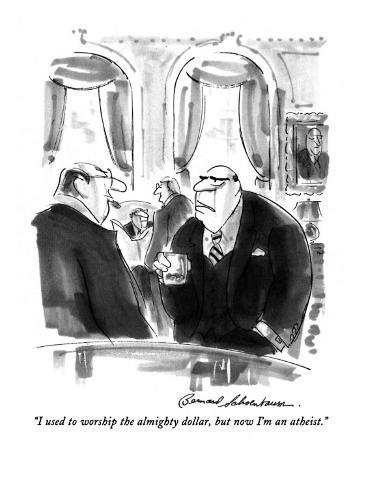
Kwanzaa is that religionish holiday we were just talking about. Kwanza is the unit of currency in Angola, our "History of" country today. Before getting to the history of Angola, I pause to think of the holidays we could invent by taking the names of the world currencies. Here's a list of the currencies currently circulating in the world. Following the Kwanzaa model, you could add a letter or change the word slightly as you take off on your flight of inspirational fancy. Now, what should we do for Dollaro? Worship the Almighty Dollar is a common enough phrase.

But let's get back to the history of Anglola, as quickly scanned via the "History of Angola" Wikipedia page, in accordance with our 206-day project. The name Angola comes from "N'gola," the Kimbundu word for king.
Read more ►
But let's get back to the history of Anglola, as quickly scanned via the "History of Angola" Wikipedia page, in accordance with our 206-day project. The name Angola comes from "N'gola," the Kimbundu word for king.
The first ones to settle were the Bushmen, great hunters, similar to Pygmies in stature. This changed at the beginning of the sixth century AD, when the Bantu, already in possession of metal-working technology, ceramics and agriculture began one of the greatest migrations in history.... The first large political entity in the area, known to history as the Kingdom of Kongo, appeared in the thirteenth century and stretched from Gabon in the north to the river Kwanza in the south, and from the Atlantic in the west to the river Cuango in the east....In 1482, the Portuguese arrived:
The Portuguese colony of Angola was founded in 1575 with the arrival of Paulo Dias de Novais with a hundred families of colonists and four hundred soldiers. Luanda was granted the status of city in 1605....The Portuguese took over again and stayed until 1975, after a coup d'etat in Portugal that installed President António de Spínola.
After undertaking various journeys [Queen Jinga] succeeded in 1635 in forming a grand coalition with the states of Matamba and Ndongo, Kongo, Kassanje, Dembos and Kissamas. At the head of this formidable alliance, she forced the Portuguese to retreat.
Meanwhile, Portugal had lost its King and the Spanish took control of the Portuguese monarchy.... Jinga entered into an alliance with the Dutch... In 1648, after Portugal has regained its independence from the Spanish rulers... a large Portuguese force from Brazil under the command of Salvador Correia de Sá retook Luanda, leading to the return of the Portuguese in large numbers.
The Spínola government agreed to give all of Portugal's colonies independence, and handed power in Angola over to a coalition of the three largest separatist movements, the MPLA, UNITA, and the FNLA, through the Alvor Agreement. The coalition quickly broke down, however, and the country descended into civil war....Cuba involved itself, and the U.S. had difficulties with that involvement. An accord was signed in 1988 and another in 1991. There were democratic elections, but the results were questioned and more war followed. It seems that the conflict ended 2002.
Thursday, 3 January 2013
"It was my first trip to Detroit, Michigan, so naturally..."
"I convinced a local to give me the 'ruins porn' tour."
ADDED: That comic got me interested in finding some photos of the Heidelberg Project. I recommend this (and then click the "older" button for more).
Read more ►
ADDED: That comic got me interested in finding some photos of the Heidelberg Project. I recommend this (and then click the "older" button for more).
Wednesday, 2 January 2013
"A paparazzo hoping to get a picture of Justin Bieber in his Ferrari after the vehicle was pulled over by police in Los Angeles got struck and killed by an SUV instead."
"And as it turned out, the 18-year-old singer wasn't even in the sports car."
This seems to be an occasion for wheeling out that horrible old saying: He died doing what he loved. He thought he had Justin Bieber set up for a shot. The photographer was swelling with delight and then — blam — not from a Ferrari but an SUV. Let's hope he never knew what hit him — to coin a phrase — and never knew that Bieber wasn't even in that car. He died doing what he loved! He had his peak of paparazzi ecstasy and then... annihilation. A consummation. It's over.
But wait! Justin Bieber wants to speak:
Now, should we also get on Bieber's case for calling what happened a "tragedy"?
ADDED: The more apt term is poetic justice — "a literary device in which virtue is ultimately rewarded or vice punished, often in modern literature by an ironic twist of fate intimately related to the character's own conduct." The key is the self-contained logic of the story. It makes sense. There should be no call for legislation to find meaning. The meaning is already there. What happened is exactly right: poetic justice. The Wikipedia page I just linked has some examples, and since we were just talking about Wile E. Coyote, I enjoyed seeing him first on the list of poetic justice in TV and film: "Wile E. Coyote always sets traps for Road Runner, only to end up in the traps themselves." The phrase "hoist with his own petard" expresses the concept. Did you know it's from "Hamlet":
Read more ►
This seems to be an occasion for wheeling out that horrible old saying: He died doing what he loved. He thought he had Justin Bieber set up for a shot. The photographer was swelling with delight and then — blam — not from a Ferrari but an SUV. Let's hope he never knew what hit him — to coin a phrase — and never knew that Bieber wasn't even in that car. He died doing what he loved! He had his peak of paparazzi ecstasy and then... annihilation. A consummation. It's over.
But wait! Justin Bieber wants to speak:
"While I was not present nor directly involved with this tragic accident, my thoughts and prayers are with the family of the victim... Hopefully this tragedy will finally inspire meaningful legislation and whatever other necessary steps to protect the lives and safety of celebrities, police officers, innocent public bystanders, and the photographers themselves."Oh, Justin. Not every screw-up is an argument for legislation. Putting "meaningful" in front of "legislation" is itself meaningful, but what does it mean? 1. It means meaninglessness, an empty existential cry in the face of helplessness. 2. It means I would like to soothe myself with the fantasy that if the right laws had been in place, the bad thing that just happened would not have happened. 3. It means that we can express meaning through laws, that laws work as expression, quite aside from whether they have any effect on the bad things we would like to call bad.
Now, should we also get on Bieber's case for calling what happened a "tragedy"?
Tragedy (Ancient Greek: τραγῳδία, tragōidia, "he-goat-song") is a form of drama based on human suffering that invokes in its audience an accompanying catharsis or pleasure in the viewing....Pedants love to say that the word "tragedy" is misused, but I think we may have encountered a correct use of the word. That correct usage seems out of place with the rest of the statement, with its angst about prayer, inspiration, and meaning. One suspects Bieber bumbled into saying something he wouldn't have meant to say. It's meaning without a mind that meant it. We witness human suffering and feel... good!
ADDED: The more apt term is poetic justice — "a literary device in which virtue is ultimately rewarded or vice punished, often in modern literature by an ironic twist of fate intimately related to the character's own conduct." The key is the self-contained logic of the story. It makes sense. There should be no call for legislation to find meaning. The meaning is already there. What happened is exactly right: poetic justice. The Wikipedia page I just linked has some examples, and since we were just talking about Wile E. Coyote, I enjoyed seeing him first on the list of poetic justice in TV and film: "Wile E. Coyote always sets traps for Road Runner, only to end up in the traps themselves." The phrase "hoist with his own petard" expresses the concept. Did you know it's from "Hamlet":
"For 'tis the sport to have the engineer / Hoist with his own petard." (Shakespeare, Hamlet (III.iv.226).)And did you know (again, from Wikipedia):
During the late 17th century, critics pursuing a neo-classical standard would criticize William Shakespeare in favor of Ben Jonson precisely on the grounds that Shakespeare's characters change during the course of the play.... When Restoration comedy, in particular, flouted poetic justice by rewarding libertines and punishing dull-witted moralists, there was a backlash in favor of drama, in particular, of more strict moral correspondence.
Subscribe to:
Posts (Atom)