Sunday, 20 January 2013

"The Kingdom of Dahomey became a major power in the Atlantic slave trade..."

0 comments
"... with slaves supplied through raids of surrounding areas.  Oyo would sometimes put pressure on Dahomey to decrease their slave trade, largely to protect Oyo's own trade, which would slow the trade for a while before it increased again...."

The place that was the Kingdom of Dahomey is now called the Republic of Benin, and it is today's "History of" country. The French took over circa 1870, and the finally let go in 1960:
Between 1960 and 1972, a succession of military coups brought about many changes of government. The last of these brought to power Major Mathieu Kérékou as the head of a regime professing strict Marxist-Leninist principles. By 1975 the Republic of Dahomey changed its name to the People's Republic of Benin. The People's Revolutionary Party of Benin (PRPB) remained in complete power until the beginning of the 1990s. Kérékou, encouraged by France and other democratic powers, convened a national conference that introduced a new democratic constitution and held presidential and legislative elections....
Read more ►

Thursday, 17 January 2013

"Americans, while occasionally willing to be serfs, have always been obstinate about being peasantry."

0 comments
Think hard. It doesn't really matter — does it? — that this is today's sentence from "The Great Gatsby," another dutiful posting in our Gatsby project, wherein we look at one sentence, out of context, each day. I know the context of that sentence. I know what happened in the story. You can look it up.

It's so tempting to break out of the form of the project and tell you, to go back into the paragraph, even as I want to tempt you out of the book altogether to look at this proposition that Americans are willing — occasionally! — to be serfs but won't accept the notion that they are peasants. What's the difference?!

But I've got to tell you. There was a rich man — not Gatsby — who tried to get the people in the houses around his house to accept having their roofs thatched with straw. He offered to pay their taxes for 5 years if they'd accept this imposition which would have allowed him to have a nice view of a faux-peasant village. They refused, and the rich man, we're told, "went into an immediate decline." And "His children sold his house with the black wreath still on the door." That's how Gatsby got his house. So that's the peasant idea that offends Americans.

But serfs. We are willing to be serfs.
Read more ►

Wednesday, 16 January 2013

"By 1666 at least 12,000 white smallholders had been bought out, died," or left Barbados.

0 comments
"Many of the remaining whites were increasingly poor. By 1680 there were seventeen slaves for every indentured servant. By 1700, there were 15,000 free whites and 50,000 enslaved blacks."
... The British abolished the slave trade in 1807, but not the institution itself. In 1816, slaves rose up in the largest major slave rebellion in the island's history. Twenty thousand slaves from over seventy plantations rebelled. They drove whites off the plantations, but widespread killings did not take place. This was later termed "Bussa's Rebellion" after the slave ranger, Bussa, who with his assistants hated slavery, found the treatment of slaves on Barbados to be "intolerable," and believed the political climate in the UK made the time ripe to peacefully negotiate with planters for freedom... Bussa's Rebellion failed. One hundred and twenty slaves died in combat or were immediately executed; another 144 were brought to trial and executed; remaining rebels were shipped off the island...
Slavery was abolished in 1834 in Barbados, today's "History of" country.

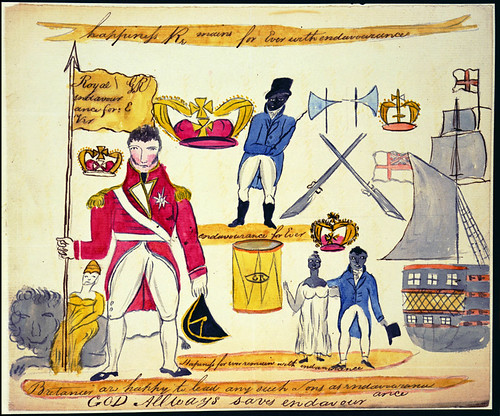
ADDED: Here— at the U.K. National Archives website — is a school lesson on Bussa's rebellion, with nice scannings of original documents for students to read. And here's a drawing taken from the rebels that "appears to stress the rebels' loyalty to Britain and to the Crown while conveying their earnest desire for liberty."

God always saves endavour
Read more ►

Monday, 7 January 2013

Archaic People, Saladoid people, Arawaks, Caribs...

0 comments
I'm trying to read the "History of" page for Antigua and Barbuda, which is a single country. It's today's country as we run through the list of 206 countries in the world. But this Wikipedia page is kind of a mess. There are names of various people who arrived in succeeding waves, mostly, it seems, paddling from Venezuela. I'm not quite picturing how one group "replaced" or "succeeded" another. But the earliest people were there by around 2900 BC. These were the "archaic people."
The Catholic Encyclopedia does make it clear that the European invaders had some difficulty identifying and differentiating between the various native peoples they encountered.
So maybe it's not just a Wikipedia problem. But you'd think by now they'd have sorted out who replaced whom, when, and how. Maybe not. Maybe my expectations for archaeology are excessive. And then there's the question: how/why did they leave?

No researcher has conclusively proven any of these causes as the real reason for the destruction of West Indian natives.
Christopher Columbus arrived in 1493, but the Caribs defended themselves. It was England that colonized the islands 1632.
Settlers raised tobacco, indigo, ginger, and sugarcane as cash crops.... [T]he sugar industry became so profitable that many farmers replaced other crops with sugar, making it the economic backbone of the islands. 
The English brought in African slaves to work in the sugar plantations.
During the 18th century, Antigua was used as the headquarters of the British Royal Navy Caribbean fleet....
... Antiguan slaves were emancipated in 1834, but remained economically dependent upon the plantation owners....

The islands achieved independence from the United Kingdom in 1981, becoming the nation of Antigua and Barbuda. It remains part of the Commonwealth of Nations, and remains a constitutional monarchy, with Queen Elizabeth II as Queen of Antigua and Barbuda.
Read more ►

Tuesday, 1 January 2013

The History of Abkhazia.

0 comments
"According to The Georgian Chronicles, the first inhabitants of what is now Abkhazia and the whole western Georgia were Egrosians, the descedants of Egros son of Togarmah, grandson of Japhet, son of Noah, who came from the land known as Arian-Kartli."


"... Abkhazia was conquered by Mithridates VI Eupator of Pontus between c. 110 and 63 BC, and then taken by the Roman commander Pompey."

"[T]he kingdoms of Abkhazia and Georgia [were united] into a single Georgian feudal state... reach[ing] the apex of its strength and prestige under the queen Tamar (1184–1213)."

"Towards the end of the 17th century, the principality of Abkhazia broke up into several fiefdoms, depriving many areas of any centralized authority. The region became a theatre of widespread slave trade and piracy. "

"In the Russian revolution of 1905, most Abkhaz remained largely loyal to the Russian rule, while Georgians tended to oppose it. As a reward for their allegiance, tsar Nicholas II officially forgave the Abkhaz for their opposition in the 19th century and removed their status of a 'guilty people' in 1907."

"On 24 October 2008 the railroad bridge of Shamgon-Tagiloni, connecting the city of Zugdidi in Georgia with the Abkhazian Gali district (populated mainly by Georgians) was destroyed. According to Georgian and French sources it was done by Russian army; Abkhazian sources maintained it was a Georgian diversion."

***

And so begins the new year project on this blog, which is to proceed, alphabetically, through the 206 countries of the world, and to read the "History of" page in Wikipedia. The idea is to have had it go through our head, at least once, something of what happened in each place. It is fitting that we start with Abkhazia, which may be an unfamiliar name. Much has happened there! It's touching to see that, to confront one's own persistent, nagging ignorance. But we are all fortunate to have woken up again this morning, still a human being on Planet Earth, and I want to perform a ritual — for the next 206 days — of adding a slight glimmer of awareness of those other human beings who live or who have lived over the long expanses of time and place.

***

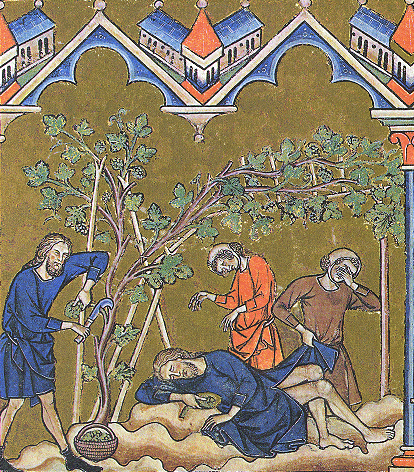
It's apt that we encounter Noah on New Year's Day, Noah being our earliest example of an individual overindulging in alcohol.


ADDED: I found a nice Flicker stream of photos from Abkhazia. I recommend beginning here — at Stalin's bathroom — and then clicking to the "newer"/"older" button to see more.
Read more ►
 

Copyright © Diet Althouse Design by O Pregador | Blogger Theme by Blogger Template de luxo | Powered by Blogger