Monday, 28 January 2013

"From medieval times until the end of the 19th century, the region of Burkina Faso was ruled by the empire-building Mossi people..."

0 comments
"... who are believed to have come up to their present location from northern Ghana, where the ethnically-related Dagomba people still live. For several centuries, Mossi peasants were both farmers and soldiers; as the Mossi Kingdoms successfully defended their territory, indigenous religious beliefs, and social structure against forcible attempts to conquer or convert them to Islam by Muslim peoples from the northwest."

Burkina Faso is today's "History of" country.


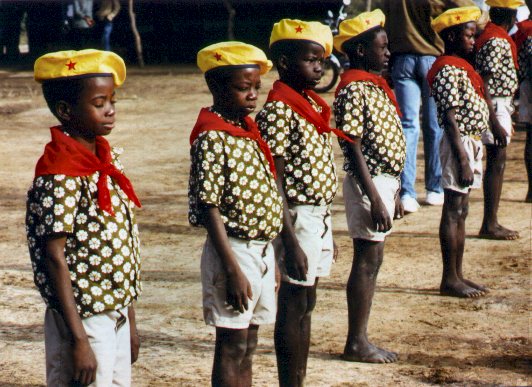
More recently, children of the 1983-1987 revolution: 

Read more ►

Saturday, 26 January 2013

"The problem, apparently, is that the Jabba the Hut Lego palace looks like a mosque."

0 comments
"And not just any mosque, but Istanbul’s great Hagia Sophia, and another mosque in Beirut, Jami al-Kabir."
Dr. Melissa Günes, General Secretary of the Turkish Cultural Community, confirmed that Lego had been contacted with an official complaint and that an Austrian toy store had removed the offending Lego sets, according to the Austrian Times.
Read more ►

"Muslim professor Mustafa Umar explained... that there is 'nothing intrinsically wrong with wearing nail polish'..."

0 comments
"... the real issue is that this substance forms an impermeable barrier over the nails preventing water from getting underneath."
For years, women have been required to either remove and reapply polish for prayers every day, or wait to wear it during the week they have their period - when they're not allowed to pray.
Solution: "Breathable" nail polish.
Read more ►

Friday, 4 January 2013

"I don’t know whether this world has a meaning that transcends it."

0 comments
"But I know that I cannot know that meaning and that it is impossible for me just now to know it."

Roman arch, Tebessa, Algeria.

Today, the "History of" project brings us to...

Algeria, where human beings have lived for at least 1.8 million years. There are prehistoric rock paintings in the Tassili n'Ajjer range. Like this:


The indigenous people have been called Berbers since 4000 BC, and they have been joined over the years by invaders of the Phoenician, Roman, Vandal, Byzantine, Arab, Turkish, and French kind.
Berber territory was annexed by the Roman Empire in AD 24. Increases in urbanization and in the area under cultivation during Roman rule caused wholesale dislocations of Berber society, and Berber opposition to the Roman presence was nearly constant....

Christianity arrived in the 2nd century AD. By the end of the 4th century, the settled areas had become Christianized, and some Berber tribes had converted en masse....

The 8th and 11th centuries AD, brought Islam and the Arabic language....

In the central Maghrib, the Abdalwadid founded a dynasty at Tlemcen in Algeria. For more than 300 years, until the region came under Ottoman suzerainty in the 16th century, the Zayanids kept a tenuous hold in the central Maghrib. Many coastal cities asserted their autonomy as municipal republics governed by merchant oligarchies, tribal chieftains from the surrounding countryside, or the privateers who operated out of their ports. Nonetheless, Tlemcen, the “pearl of the Maghrib,” prospered as a commercial center.

The final triumph of the 700-year Christian reconquest of Spain was marked by the fall of Granada in 1492. Christian Spain imposed its influence on the Maghrib coast by constructing fortified outposts and collecting tribute. But Spain never sought to extend its North African conquests much beyond a few modest enclaves. Privateering was an age-old practice in the Mediterranean, and North African rulers engaged in it increasingly in the late 16th and early 17th centuries because it was so lucrative. Algeria became the privateering city-state par excellence.....

Algeria and surrounding areas, collectively known as the Barbary States, were responsible for piracy in the Mediterranean Sea, as well as the enslaving of Christians, actions which brought them into the First and Second Barbary War with the United States of America.
Colonization by the French began in 1830.
Viewed by the Europeans with condescension at best and contempt at worst, the Algerians endured 132 years of colonial subjugation. From 1856, native Muslims and Jews were viewed as French subjects, but not French citizens.

However, in 1865, Napoleon III allowed them to apply for full French citizenship, a measure that few took, since it involved renouncing the right to be governed by sharia law in personal matters, and was considered a kind of apostasy; in 1870, French citizenship was made automatic for Jewish natives, a move which largely angered the Muslims, who began to consider the Jews as the accomplices of the colonial power. Nonetheless, this period saw progress in health, some infrastructures, and the overall expansion of the economy of Algeria, as well as the formation of new social classes, which, after exposure to ideas of equality and political liberty, would help propel the country to independence. During the years of French domination, the struggles to survive, to co-exist, to gain equality, and to achieve independence shaped a large part of the Algerian national identity....

A new generation of Islamic leadership emerged in Algeria at the time of World War I and grew to maturity during the 1920s and 1930s. Various groups were formed in opposition to French rule....

The Algerian War of Independence (1954–1962), brutal and long, was the most recent major turning point in the country's history. Although often fratricidal, it ultimately united Algerians and seared the value of independence and the philosophy of anticolonialism into the national consciousness....

Between 350,000 and 1 million Algerians are estimated to have died during the war, and more than 2 million, out of a total Muslim population of 9 or 10 million, were made into refugees or forcibly relocated into government-controlled camps. Much of the countryside and agriculture was devastated, along with the modern economy, which had been dominated by urban European settlers (the pied-noirs). French sources estimated that at least 70,000 Muslim civilians were killed or abducted and presumed killed, by the [Front de Libération Nationale] during the Algerian War. Citizens of European ethnicity... and Jews were also subjected to ethnic cleansing. These nearly one million people of mostly French descent were forced to flee the country at independence due to the unbridgeable rifts opened by the civil war and threats from units of the victorious FLN; along with them fled Algerians of Jewish descent and those Muslim Algerians who had supported a French Algeria (harkis). 30-150,000 pro-French Muslims were also allegedly killed in Algeria by FLN in post-war reprisals....

On 19 June 1965, Houari Boumédienne deposed Ahmed Ben Bella in a military coup d'état that was both swift and bloodless....

Boumédienne’s death on December 27, 1978 set off a struggle within the FLN to choose a successor....

After the violent 1988 October Riots, a new constitution was adopted in 1989 that allowed the formation of political associations other than the FLN....

Among the scores of parties that sprang up under the new constitution, the militant Islamic Salvation Front (FIS) was the most successful....

In 1996 a referendum introduced changes to the constitution, enhancing presidential powers and banning Islamist parties. 
Abdelaziz Bouteflika became president in 1999 and "concentrated on restoring security and stability." He remains president to this day.

Read more ►

Thursday, 3 January 2013

And our "History of" country today is...

0 comments


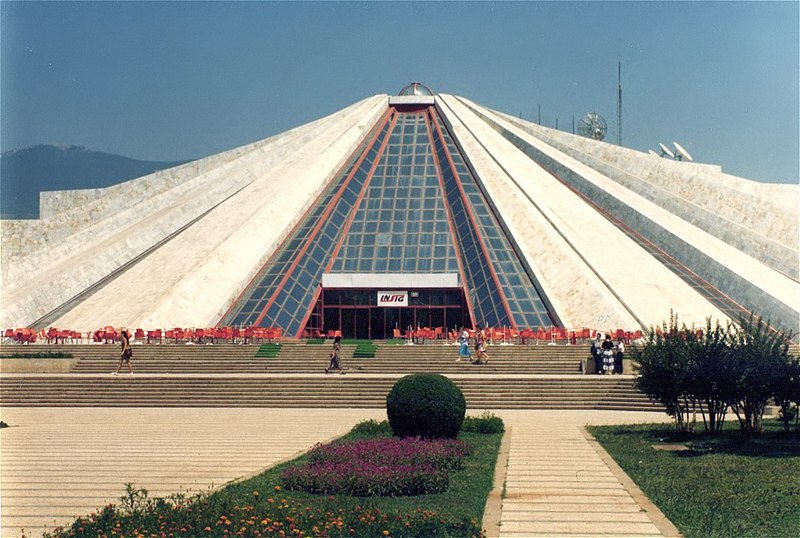
Do you recognize where this is? A clue: That's a photo of what used to be called the Enver Hoxha Mausoleum. If I told you it's in the capital city of Tirana, would you know the country, or is it easy because we are proceeding through the Wikipedia "History of" pages for the 206 countries in the world in alphabetical order?


This is Albania, a region where, in antiquity, the Illyrians lived. There was Roman rule, Byzantine rule, invasions by Visigoths, Huns, and Ostrogoths, the Bulgarian Empire, and the Ottoman Empire:
Part of the Albanian population gradually converted to Islam, with many joining the Sufi Order of the Bektashi. Converting from Christianity to Islam brought considerable advantages, including access to Ottoman trade networks, bureaucratic positions and the army.... The Albanians proved generally faithful to Ottoman rule following the end of the resistance led by [feudal heir] Skanderbeg, and accepted Islam more easily than their neighbors. No fewer than 42 Grand Viziers of the Empire were of Albanian descent....

[I]n the 19th century... an Albanian National Awakening took place and many revolts against the Ottoman Empire were organized...

The Principality [of Albania] was established on 21 February 1914. The Great Powers selected Prince William of Wied, a nephew of Queen Elisabeth of Romania to become the sovereign of the newly independent Albania....
There was WWI, then the rule of King Zog, who initiated reforms (such as ending the custom of making one's region part of one's name) and who was overthrown by the Italians under Mussolini in 1939. Mussolini "saw Albania as a historical part of the Roman Empire" and imposed "a policy of forced Italianization." After the Italian surrender in 1943, Germany occupied Albania. Germany "sought to gain popular support by backing causes popular with Albanians, especially the annexation of Kosovo.... Albanian collaborators... expelled and killed Serbs living in Kosovo."

After the Soviets liberated Albania in 1944, Enver Hoxha, the secretary general of the Albanian Communist Party, became the leader of the Socialist People's Republic of Albania, and he continued on in that role for 41 years, until he died in 1985.
In 1967, the authorities conducted a violent campaign to extinguish religious practice in Albania, claiming that religion had divided the Albanian nation and kept it mired in backwardness. Student agitators combed the countryside, forcing Albanians to quit practicing their faith. Despite complaints, even by APL members, all churches, mosques, monasteries, and other religious institutions had been closed or converted into warehouses, gymnasiums, and workshops by year's end.
The Communists were defeated by the Democratic Party in 1992. Efforts to introduce capitalism — Wikipedia says — "led to the proliferation of pyramid schemes" and "anarchy," which was stabilized by "an EU military mission led by Italy." In 2009, Albania joined NATO.

That's enough from Wikipedia for now. I can't vouch for the accuracy of any of that, but it's a jumping off place that is far beyond anything I'd had in my head before reading it. Enver Hoxha? Previously unfamiliar to me. And his erstwhile mausoleum? Horrific. Looking for better images, I found this nice Flickr stream, and I'll send you to this image first, because I love it. Then you you can click the "newer"/"older" buttons to see what else is there.
Read more ►
 

Copyright © Diet Althouse Design by O Pregador | Blogger Theme by Blogger Template de luxo | Powered by Blogger